

 The Washington Fair Trade Coalition consistently communicates with members of congress in an effort to change trade policy in a way that will directly benefit people, not just the "economy." The media and politicians show us graphs with numbers that will placate our fears about our trade deficit, the latest free trade agreement, and low inflation, but groups like WFTC are working to reveal the reality of the problems these policies impose on people in the US and around the world. WTFC employs a participatory approach to achieve their goals, gaining a presence in government by maintaining contact with members of congress in the hopes of influencing their decisions. While it is a constant struggle, some of their campaigns have been successful in reforming trade policy and mitigating the destructive effects that current policies have on workers and the environment. See their website for more information about what they do and recent success in swaying some policy-makers: http://www.washingtonfairtrade.org/ While it is unfortunate how hard they have to work to influence policy, it is at the same time uplifting to know that people are actively taking part in decisions that most are content to leave to representatives and government officials. -Editor
Congressional Leaders Launch Bold New Trade Reform Act
The Washington Fair Trade Coalition Urges Washington State Members of Congress to Co-sponsor Legislation
Source: http://www.citizenstrade.org/pdf/WFTC_TRADEActpressrelease_06102008.pdf
Over fifty original House and Senate cosponsors joined twenty leading labor, environmental, family farm and faith groups in supporting new consensus legislation offering a positive vision for future U.S. trade policy. Entitled the Trade Reform, Accountability, Development and Employment (TRADE) Act (H.R. 6180), the bill was introduced by Sen. Sherrod Brown (D-Ohio) and Rep. Mike Michaud (D-Maine) on June 4th, 2008 in Washington D.C. None of Washington State's members of Congress were original co-sponsors.
The act triggers a review of all existing trade agreements, and provides a process to renegotiate them. The bill also outlines principles of what should be included in future trade agreements, and expresses the sense of the Congress that their role in trade policymaking should be strengthened.
Rick Bender, President of the Washington State Labor Council, supports the TRADE Act. "It is time we get some teeth in our trade agreements and require real protections for both workers and the environment," said Bender. "We must no longer treat these vital concerns as a sidebar to broader economic interests. Securing the future of workers and the health of the planet will benefit everyone - business and labor included."
No member of the Washington State Congressional delegation was an original co-sponsor of the bill. However, many local organizations are already praising it as a bold step forward on trade policy, and are encouraging state officials to sign on.
"This bill is ground-breaking. It is an opportunity to restore balance in our trade agenda, between business and investor interests on one hand, and the interests of communities and the public on the other hand," comments Cynthia Cole, President of SPEEA, the union of Boeing engineers and technical workers. "Hopefully, Congress members from Washington State will be quick to support a new model for trade that will benefit working people as well as businesses in our state."
Environmental groups see this bill as important for ensuring trade and environmental concerns are complementary. Kathleen Ridihalgh of Sierra Club Northwest/Alaska Region says: "This Act has the potential to set straight the history of NAFTA and the WTO to encourage truly sustainable development that promises to benefit the majority of the world's people, whether farmers or business owners, while protecting our resources for future generations."
Kristen Kosidowski of Witness for Peace Northwest sees this bill as an opportunity to be in favor of trade policy, since many social justice groups often find themselves opposed to trade agreements. "The TRADE Act is exactly the step that we need to take. Over and over we've had to say "No!" to trade policies that set up our local working communities and our global neighbors for failure, but the TRADE Act gives us hope for a trade model that we can support - one that is of the people and for the people."
The TRADE Act was introduced following a presidential primary season that saw trade policy rise to the top of American's concerns. With several Democratic candidates promising to renegotiate existing agreements (visit www.citizenstrade.org/positions.php for those commitments), the TRADE Act provides a blueprint for how to best remedy many of these past problems in trade agreements.
The current U.S. trade model has had devastating impacts. Since 1975, when Fast Track (Trade Promotion Authority) was first enacted, the trade deficit has gone from a slight surplus to an unsustainable $709 billion deficit in 2007. A net 4.7 million manufacturing jobs have been lost. In Washington State almost 14,000 workers have applied for Trade Adjustment Assistance, which indicates that our current trade model caused them to suffer job loss or reduced income. This represents only a fraction of the total number of those whose jobs or livelihoods have been negatively impacted by the NAFTA-style trade model, including thousands of Mexican farmers who have immigrated to Washington State in search of a livelihood after the collapse of the Mexican rural economy.
According to Stephanie Celt, Director of the Washington Fair Trade Coalition, "More and more Americans are realizing that our current trade model hurts more people than it helps. I hope that Congress members from Washington State will act on this important opportunity to support a truly fair trade bill that will benefit our state as well as the world at large."
CLICK ON YOUR STATE FOR CURRENT BALLOT MEASURES - COURTESY OF BALLOTPEDIA
Friday, July 25, 2008
WASHINGTON FAIR TRADE COALITION: PARTICIPATING IN TRADE REFORM


Wednesday, July 23, 2008
CYNTHIA McKINNEY, GREEN PARTY CANDIDATE

July 15, 2008
*At its convention in Chicago over the weekend, the Green Party selected former Democratic Congresswoman Cynthia McKinney of Georgia as its presidential nominee, with hip-hop artist, journalist and activist Rosa Clemente as her running mate.
In 1992, McKinney, 53, became the first African American woman to represent Georgia in Congress. She has been a vocal opponent of the Iraq war, has called for new investigations into the 9/11 attacks, sought justice for victims of Hurricane Katrina, and introduced articles of impeachment against President Bush, Vice President Cheney and Secretary of State Condoleezza Rice.
In 2006 McKinney got into a scuffle with a Capitol Police Officer after passing through security without an identifying lapel pin. She later apologized on the floor of the House.
Clamente, 36, born in the Bronx and of Puerto Rican descent, became an activist and journalist after being angered by the Bush administration's response following Hurricane Katrina.
"I choose to do this, not for me, but for my generation, my community and my daughter," Clamente said of the nomination. "I don't see the Green Party as an alternative; I see it as an imperative."
On Saturday she described the campaign as an opportunity for the Hip-Hop generation: "We must remember that youth have always taken risks. From the Soweto uprisings in South Africa, to African-American and Mexicano children in the '50s and '60s who walked out of schools, to the 17-, 18- and 19-year old men and women who joined the ranks of the Student Non-Violent Coordination Committee, the Black Panther party, the American Indian movement, the Black Liberation Movement, the Young Lords Party - young people have always been the catalyst of change."
Green party ideals include environmentalism, non-hierarchical participatory democracy, social justice, respect for diversity, peace and nonviolence.
And the Green Party has nominated former Democratic Congresswoman Cynthia McKinney to be the party’s presidential nominee. The Greens also nominated hip-hop activist and organizer Rosa Clemente to be McKinney’s running mate. McKinney spoke on Saturday at the Green Party convention in Chicago.
Cynthia McKinney: “And when I got to Washington, I saw that public policy is really made in a room at a table. There were real seats at the table. Well, imagine what has happened to public policymaking now. There is a real room with a window and a door, and there’s two seats at the table. The window is for us to look through, while our representatives make policy for us, so we can see what they’re doing. At the table, one seat is for the Democrats, one seat is for the Republicans. Now, we don’t know who did it, but one of them put a lock on the door and slipped a key to the corporate lobbyists who can come and go at will and whisper what they want to Democrats and Republicans, and the result is that we the people, who pay for those seats and determine who sits in them, want one thing, but because the corporate lobbyists can come and go at will, our values get overridden and our representatives give us something else. That’s how we end up with everyone saying they’re against the war and occupation, but war and occupation still gets funding. That’s how we end up with everyone saying they’re against illegal spying on innocent people, yet end up with a telecom immunity bill being signed into law. That’s how we end up with everyone saying they’re in favor of universal access to healthcare and no one supporting what the physicians, nurses and healthcare really want, and that’s a single-payer healthcare system in this country.”
Monday, July 21, 2008
WINNING AND RUNNING THE PRESIDENCY AS A PARTICIPATORY DEMOCRACY

Winning -- and Running -- the Presidency as a Participatory Democracy
By Craig Newmark - Huffington Post
Posted July 8, 2008 03:50 PM (EST)
Source: http://www.huffingtonpost.com/craig-newmark/winning----and-running_b_111498.html
This election is historic, it's the beginning of a long tipping point where networked citizen involvement in the election marks the start of large scale participatory democracy. This year is comparable to 1787, when the Founders defined our system of representative democracy.
As more of us get Net access, we're getting the tools for the kind of representative democracy the Founders envisioned. Whoever wins the presidency will be faced with an electorate that is genuinely empowered. (There's still a digital divide issue, slowly being addressed.)
Barack Obama has signified his commitment to a role for American citizens in his election and his presidency, and he's following through with his commitment. (more below)
John McCain, who I admire, seemed to start with a similar vision, but has recently committed to sharing the current administration's view of democracy: "The American people have input every four years, and that's the way our system is set up." (video here). (Note that he's now hiring people with a record of deceptive campaigning; check out the first link.)
1. The financial contributions of ordinary citizens, including myself, constitute the best of Americans demonstrating their dedication to shared values. It's the most genuine, honest form of public electoral financing. Given the choice between genuine, grassroots electoral financing, and a coercive, tax-based public financing, the grassroots approach is the one consistent with American values.
So, the factual perspective is that Obama honored his commitment to honest public financing by refusing taxpayer based public financing. However, swiftboaters have already used this material for deceptive advertising. Additionally, commentators who don't understand participatory democracy have misinterpreted it.
2. Many parts of the FISA Amendment Act are subject to debate. However, in America, no one should be above the law, including telcoms who may have broken the law.
It should be noted that the Qwest case established that illegal wiretapping started well before the current Adminstration was interested in counterterrrorism, and that intelligence specialists have stated that current FISA mechanisms are effective. One might observe that Ronald Reagen never broke the law in this manner to fight Communism.
I feel Obama has the right position, and is also listening to the grassroots efforts opposing amnesty for illegal activities on the part of the telecoms.
3. After the inauguration of President Obama, real change will be facilitated by the evolution of the grassroots network into an effort for participatory governance. This is a matter of considerable discussion, but some concrete examples include:
-- transparency: all governmental work should be disclosed in an easily accessible manner. If we all can see how the sausage is made, at least it could be made increasingly better. Naturally, there will be sensitive matters which should not be disclosed. (credit to Jeff Jarvis.)
-- customer service and accountability: the success of city customer service call centers, that is, 311 systems, should be expanded to all government operations.
-- speaking truth to power: the current presidency illustrates the danger when the executive is isolated from the reality of his actions, that is, when kept in a bubble. The grassroots network could be used to provide an alternative means of letting the president really know what's going on.
The participatory movement and concrete efforts like these are the kind of change people talk about.
Thursday, July 17, 2008
NEW YORK STATE NEEDS INITIATIVE AND REFERENDUM

Little Initiative
By Sydney Fisher
Source: http://www.academic.marist.edu/shaffer/lilin.html
In California, it succeeded by outlawing mandatory quotas for hiring practices and admittance to public institutions. In Massachusetts, it has put an annual cap on previously unchecked property taxes, making it more difficult to call the New England state by its notorious nickname: "Taxachusetts." But in New York state, the initiative and referendum (I&R) process continues to elude voters.
As the Republican candidate for governor in 1994, George Pataki vowed had bring I&R to New York. He issued a promise in his inaugural speech, saying, "I will ... give the people ' the dean unmistakable democratic voice that is theirs with the right of initiative and referendum."
While making good on other campaign promises-from reinstating the death penalty to lowering taxes--the governor has shown no sign of advancing I&R beyond his failed attempt in 1995, when he circulated his proposed bill in the Legislature. His spokesman, Michael McKeon, says the governor still hopes to bring I&R to New York. But currently, it is not among PataUs priorities. "Right now the governor is focusing on ending Darole for first-time violent felons, building on his welfare reform success; and job creation," McKeon says.
For New York's recently reform-minded Legislature, which has embraced conference committees and has approved making campaign funding information available over the Internet, I&R also remains on the back burner. For many lawmakers, the primary argument against I&R is that it undermines the deliberative process of government by allowing the electorate, rather than the people in elective office, to make the laws.
"The systems of campaigning and electing representatives every two yew for legislative office are working properly," says Mark Hansen, spokesman for Senate Majority Leader Joseph Bruno, in dismissing I&R , which frequently is used to enact policy-such as term limits--opposed by many lawmakers.
Conservative and liberal advocates and certain lawmakers and candidates for office, nevertheless are continuing their crusade to bring I&R to the Empire State. Polls, too, show as many as two-thirds of New Yorkers favor the process.
I&R is about "my voice counts," says Mark Dunlea, chairman of the legislative committee for New York Greens. It gives voters a stronger voice on issues, he says. And if "citizens feel they are listened to, they'll get more involved," Dunlea says.
In April of this year, the New York Public Interest Research Group (NYPIRG) released a report that analyzed 20 years of election data from all 50 states and the District of Columbia. The study revealed that the average voter turnout for states with I&R was 52 percent compared to states without I&R, which reported an average of 46.5 percent. New York ranked 37th out of 50 states, with 44 percent of voters going to the polls .
Initiative and referendum is often referred to as "direct democracy" or "citizen lawmaking." An "initiative" is a process allowing people to petition and put amendments or legislation on the ballot for voter approval. Referendum, used less often, is a ballot measure that allows for final voter approval of a newly enacted law, by petition, from the Legislature. In both cases, the process enables the electorate a more direct, immediate say on public policy matters such as tax, campaign finance and tort reforms.
I&R had its antecedent in the 1600s when New Englanders held town meetings. The people used the forums to place ordinances and other issues on the agenda for discussion and a vote. Contemporary I&R is adapted from the Swiss, who have used it since the mid-1800s. In this country, I&R was first adopted by South Dakota 100 years ago when the progressive movement -which ushered in reforms such as women's suffrage and the direct elections of U.S. senators-swept across the western United States. Progressives hoped I&R would eliminate the ills associated with certain political machines.
States today can adopt the I&R process by having their legislatures approve an I&R amendment, or by holding a constitutional convention in which the delegates decide to adopt an I&R amendment. In either case, the proposed amendment must be placed on the ballot for voter approval.
From 1898 to 1997, voters in the 24 states with I&R have approved 39 percent of the 1,650 measures placed on state ballots. I&R's use has accelerated in recent years, making it one of the most prevalent mechanisms for altering and influencing public policy on the local, state and national levels. In 1996 alone, 20 states voted on 90 initiatives, an unprecedented number. In 1 986, the total count was 41.
Dane Waters, president of the Initiative & Referendum Institute in Washington, D.C., says this trend toward increased use of I&R stems from the legislature's inability or unwillingness to act because of self-interest and/or conflict of interest. While the states allowing I&R have increased their use of the process, non I&R states are not rushing to join them. In 1992, Mississippi became the first state to adopt I&R since Florida implemented it two decades earlier.
Opponents point to California to justify their disdain for the process. You need to be mindful of the California experience," says Patricia Lynch, spokeswoman for New York Assembly Speaker Sheldon Silver.
Many of I&R's critics point to California's Proposition 13, considered the grandfather of initiatives, which froze property taxes at 1978 values and drained the state of a major source of revenue, causing its infrastructure to fall into further disrepair.
Tracy Westen, president of the Center for Government Studies in Los Angeles, says California's I&R process is too rigid. Once a bill is given an official title and summary by the state Attorney General's Office and circulated, it can't be amended by anyone, including its proponents, for any reason, even if mistakes are found. Westen's organization is trying to pass a ballot initiative in 2000 that would build greater flexibility into the process.
Dale Maharidge, a journalism professor at Stanford University, is. critical of the knee-jerk response at the voting booth when it comes to initiatives like California's Propositions 187---considered an anti-immigration measure-and 209-which ended affirmative action-that he says disproportionately affect minorities. "Its like using a sledgehammer to solve the problem that needs a scalpel," he says.
In his book The Coming White Minority, Maharidge examines how some propositions pander to peoples' xenophobic fears, especially those of wealthy whites over the age of 50 who comprise 42 percent of Californias electorate. "I&R makes the lawmakers reluctant to do anything," he says. "lt's a cop-out for the legislators who delegate the unpleasant task to the voters."
Maharidge's advice to those considering the adoption of I&R: "Get on your horse and ride the other way. The disadvantages outweigh the advantages. Most of the time, big money and, xenophobia speaks."
But the Center for Govemmenes Westen says I&R frequently performs its traditional role, and does so positively. "It puts out measures to get things done when the legislature refilses to do anything," he says.
In 1988, for example, California lawmakers tried to increase the sales tax on cigarettes, but the bill never got out of committee. Voters bypassed the Legislature, raising a ballot initiative. The measure passed, even after tobacco interests spent $21 million on a media campaign to quash it.
Advocates also point to California passing three initiatives on campaign finance reform, two in 1988 and one in 1996 concerning contribution limits and expenditure ceilings for public financing. All three have been declared unconstitutional by the courts.
Waters of the I&R Institute says New York's neighbor to the east exemplifies how a "Partnership between the people and the legislature" can work. Massachusetts, which adopted I&R by constitutional convention in 1918, has the nation's 14th highest voter turnout rate and uses what's called an indirect initiative to pass statutes. Instead of appealing directly- to the voters, indirect initiative requires petitioners to gather signatures from at least 3 percent of the total number of people who cast ballots for governor in the last gubernatorial election to send their initiative to the Legislature. If it is approved, and petitioners agree to any amendments made, the measure is signed into law. If it is rejected or the petitioners don't like the Legislature's proposed, changes, they may gather an additional half percent of the signatures and place the bill on the ballot.
Dorthea Vitrac, executive director of LIMITS, a term limits organization based in Braintree, Mass., says I&R is stiff homegrown and largely volunteer-based in her state, unlike in California, where millions of dollars are needed to fund a campaign. "On this year's ballot, voters will decide on tightening up campaign finance reform, whether or not to cut taxes on investment income, and whether tollbooths should be removed from the state turnpike," she says.
In 1980, Massachusetts voters approved the state's most significant ballot measure to date, Proposition 21/2. Like California's Proposition 13, it capped property taxes at 21/2 percent of valuation annually. Without it, Vitrac says, no one would be able to afford to live in the state. "They didn't call us 'Taxachusetts' for nothing," she says. "Its tragic for states that don't have it. It's a tool for the people. It's a way to get around the Legislature when they don't respond."
The procedure for enacting I&R in New York is a long one. A constitutional amendment authorizing it must be passed by two consecutive, separately-elected legislatures. The measure then would go to voters in, of all things, a statewide referendum.
In 1995, legislators rejected Pataki's proposed I&R bill, which called for direct initiative, limits on campaign contributions and gathering signatures equal to 5 percent of the total ballots cast during the last gubernatorial election. Similarly, the legislators have consistently ignored a bill sponsored by Republican Sen. Frank Padavan of Queens, which calls for indirect and direct initiative, along with gathering signatures equal to 6 percent of the total votes cast in the previous gubernatorial election.
According to NYPIRG's April report, I&R bills have also been circulated by Sens. Richard Dollinger, a Rochester Democrat, and Michael Nozzolio, a Seneca Falls Republican; and by assemblymen Joseph Robach, a Rochester Democrat, and John Bonacic, a Middletown Republican. But the first discussions of bringing I&R to New York date to the states first constitutional convention in 1894.
At NYPIRGs Albany press conference to release the report in April, groups from the liberal New York Greens to the conservative New Yorkers for Constitutional Freedoms, a Bible-based lobbying group, voiced their support. NYPIRG's legislative counsel, Russ Haven, believes I&R would be a healthy addition to what he says is New York's entrenched, ossified Legislature. "[I&R] would hold legislators accountable," Haven says. "Legislators would be more responsive to voters' needs and would put more pressure on their jobs."
But I&R also has its drawbacks, he warns, since image-conscious lawmakers could "Punt" on sensitive issues, leaving it up to the electorate to make difficult choices. Dunlea of New York Greens, however, says, It's possible for citizens to vote on issues they care about. Like what type of health care system we want, what type of gun controls ...we want in our state, or how ... we regulate the utility companies." Without I&R, says the Rev. Duane Motley, executive director of New Yorkers for Constitutional Freedoms, citizens are largely locked out of the government's Affairs. "If we had I&R,we would have passed the death penalty long ago," he says. "Polls showed that 70 [percent to] 80 percent of New Yorkers were in favor of the death penalty."
Bringing I&R to New York state is a daunting task because it threatens lawmakers, says Tom Carroll, president of CHANGENY, an anti-tax group favoring the process. In 19 of the I&R states, he notes, the people imposed term limits in addition to other measures not always popular with politicians, such as tax and campaign finance reforms. "It's a 'Catch-22,"' he says. "Those who give up power to the people are the ones who get to decide if voters will get the power."
Lynch, spokeswoman for Silver-a critic of term limits-contends the speaker's opposition to I&R has nothing to do with fear of elected officials losing power. Rather, she says, the purest form of democracy is the voters' privilege to cast a ballot every two years for their elected officials.
While New York doesn't have I & R statewide, it does hold referenda to approve not only constitutional amendments but also certain bond issues. Voters in 1996 approved the $1.75 billion Clean Water/Clean Air Environmental Bond Act, for example. In 1997, they shot down a $2.4 billion school construction bond act and a measure that would have convened a constitutional convention.
On the local level, 63 chartered cities and municipalities have limited I & R under Section 37 of New York's Municipal Home Rule Law(MHRL), which "grants authority to localities …. To pass laws."
According to a report on intergovernmental affairs by Columbia Law School professor Richard Briffault, the current version of the law, adopted in 1963, extended home rule to towns and villages. New York's first home rule law was enacted in 1894 to protect cities' "property, affairs, and government" from legislative "Meddling."
Putting a measure on the ballot has proved extremely difficult and costly. In 1993, Allen Roth, executive director of New Yorkers for Term Limits, petitioned to get an initiattive placed on the ballot that would impose term limits on NewYork City's mayor, city council members, borough presidents, and selected other elected officials. After what he calls a "strenuous and exacting process" of gathering the required 35,000 signatures (the organization gathered 100,000 to be safe), Roths group submitted its petition to the city clerk responsible for seeing that the bill complied with the MHRL criteria. The city council rejected the petition limiting officials to two terms in office.
Before campaign organizers gathered another 15,000 signatures to put the measure on the ballot, the city clerk sued RotEs orga:nization, charging that the bill wasn't a valid charter initiative.
The state Court appeals declared the proposed amendment legal and placed it on the ballot. To the politicians' disappointment, the measure passed and ten-n limits were installed. The city council tried unsuccm0y to overturn the amendment in 1996.
Even with the tradition of home rule, Rochester Sen. Dollinger, a vocal I&R proponent, says he believes the chances of New York adopting the process statewide are slim to none. "I don't think it'll ever happen," he says. "I don't think the Legislature will voluntarily give up the power." But, he adds, New York could perhaps get I&R by amending the state's constitution during a constitutional convention.
The I&RInstitute's Waters plans to help New York adopt the process. He recently founded Americans for Sound Public Policy (ASPP), a conservative advocacy group whose mission is to protect the rights of I&R states and to bring the process to the 26 states that do not yet have it. Waters says he is looking to become active in New York by the year 2000.
"With a concerted, multiyear process, lots of money and ongoing education, New York has a good chance of getting it," Waters says. 'A few years ago, privatized Social Security was unthinkable, now its very realistic. The same could happen with I&R."
Tuesday, July 15, 2008
LOCAL VOTING CHANGES CAN HELP PARTICIPATION
 An editorial piece from a Burlington, VT paper provides insight to greater issues of participation in local politics by focusing on specific issues that the community faces. Increasing participation in the democractic process requires different approaches for different communities with differing demographics. But above all, as this author points out, we all need to participate more in local governance issues if we wish to have some control over our daily lives and our communities.
-Editor
Editorial: Local voting changes can help participation
June 20, 2008
Source: http://www.burlingtonfreepress.com/apps/pbcs.dll/article?AID=/20080620/OPINION/806200301/1006
The more people take part, the better democracy works. One Chittenden County community is returning to a town meeting tradition in hopes of increasing participation, while another is moving in the opposite direction with the same aim.
South Burlington is moving in the right direction as it looks at bringing its election date in line with the day that most Vermont communities take care of business having to do with local governance. So is Westford by voting to replace its traditional town meeting with daylong secret balloting.
Westford's decision to end town meetings is a concession to the fact that typically only a small portion of voters turn out for a daylong gathering, with fewer and fewer people unable to take the time away from work to attend. The tradeoff is the loss of the face-to-face meeting, an opportunity to connect with neighbors in a shared enterprise and the chance to hear various sides of an issue right up until it's time to come to a decision. But how much value is there in the give and take if too few people can take part?
South Burlington City Council is considering changing the date of municipal and school elections to the first Tuesday in March. Town Meeting Day is a focus of heavy news coverage around the state, and even garners national attention. That kind of publicity and civic enthusiasm is difficult to replicate for a single community's election in May, when South Burlington holds its annual vote.
Moving South Burlington's vote to Town Meeting Day is sure to raise voter awareness and help voter turnout. Increasing turnout is especially important because, since voters approved a charter change in 2006, the city and school district must submit their budgets to voter approval each year.
The annual town meeting, a New England exercise in direct democracy that goes back more than 200 years, is still an important event that helps define Vermont. That's why Town Meeting Day is such an important reference point for so many communities.
If moving the vote to Town Meeting Day means more people turn out to vote, it is a move worth making. If switching from a town meeting to daylong balloting means more people can take part in making decisions about town business, that, too, is a sensible change.
Any town that seeks to change the way the people's business is conducted must make certain that those changes serve the democratic process. The changes in South Burlington and Westford will do that by increasing the likelihood that more people's voices will be heard through the ballot box.
Monday, July 14, 2008
CALIFORNIA: EIGHT PROPOSITIONS MAKE IT TO NOVEMBER BALLOT
 This article illustrates one of the ways that direct democracy currently functions in the State of California: through the initiative process. Since not all states have direct democratic institutions, California is certainly an example from which other states should learn. They are able to tackle difficult and pertinent issues like street violence and clean energy that require the input of diverse individuals rather than relying solely on the whims of a select group of elected officials . However, for this type of system to function efficiently and effectively, it must be ensured that the electorate is properly educated about the issues at hand and that the petition process is accessable to everyone. Too often the process is exclusive to those interests who have vast financial resources with which to gather the required signatures. This editor would like to know more about who is participating in these petition drives and who is unknowingly being affected by these policies. What kind of outreach programs and public relations do these groups use to incorporate various actors? As has been said here before, cooperation with local communities make for more well-rounded consideration of the issues and a truer democratic process. - Editor
By JOHN C. OSBORN , The Eureka Reporter
Published: Jun 3 2008, 11:43 PM
Eight propositions will make their way to the Nov. 4 general election ballot, with topics ranging from abortion to the sentencing of non-violent offenders.
Only about half the states in the U.S. have ways in which the public can create law through direct democracy practices. Proponents of initiatives must gather a certain number of signatures before moving to the ballot for all to vote on.
Individuals, businesses and organizations can start initiative campaigns that amend California’s constitution or create a new law.
According to the California State Department Web site, 25 initiatives and referenda are in circulation, 17 failed, three are pending signature verification and two are having the signatures counted.
The final day for initiatives to be considered for the ballot is June 26.
The eight that made it to the ballot vary in scope and topic.
Below is a brief summary of what each proposition would do if passed in November based on information from the California State Department:
California Marriage Protection Act
As the California Supreme Court ruled on May 15 to overturn a ban on same-sex couples voted into law back in 2000, an organization is trying to amend California’s Constitution to overrule the court’s decision.
The proposition, if it is approved in November, would allow only recognize marriages between a man and a woman. It would also overturn the Supreme Court’s decision.
California is the second state in the U.S. to recognize same-sex marriages — Massachusetts was the first.
A total of 694,354 signatures were needed to put this on the ballot — proponents collected 1,120,801.
Non-violent Offender Rehabilitation Act of 2008
This proposition would attempt to modify sentencing, parole and probation guidelines for non-violent offenders, as well as focus on treatment and rehabilitation for nonviolent drug offenders.
It would increase funding toward individualized treatment and rehabilitation programs for both non-violent drug offenders and parolees.
At the same time, this proposition would reduce criminal penalties for those offenses by offering a different form of probation focused on treatment.
The court would have their ability to incarcerate parole and probation violators limited.
It would also shorten the amount of parole time for most drug offense, including sales, and non-violent property crimes.
The Legislative Analyst and Director of Finance expects that it would cost the state no more than $1 billion annually to expand drug and rehab programs. At the same time, no more than $1 billion annually would be saved in reduced prison and parole operation costs.
They also expect a one-time savings of no more than $2.5 billion in prison facility costs. The cost to run these expanded treatment facilities is unknown.
A total of 433,971 signatures were needed to put this on the ballot — proponents collected 761,183.
Safe Neighborhood Act: Stop Gang, Gun, and Street Crime
On the flip side of the previous proposition, this one would increase criminal penalties for several crimes and allow hearsay evidence in certain instances.
Funding would be allocated to combat crime and gangs, and toward prisons and parole operations.
Several crimes that would see increases include using and selling methamphetamine and carrying a loaded or concealed firearm for certain felons.
Bail would be eliminated for illegal immigrants charged with gang-related or violent crimes.
It would also change the law to allow certain hearsay statements as evidence if witnesses are unavailable.
The Legislative Analyst and Director of Finance expect costs to state to exceed $500 million annually for increased criminal justice programs and for prison and parole operations.
There would also be a one-time cost that could exceed $500 million toward prison facilities and costs to courts, county jails and local criminal justice agencies.
A total of 433,971 signatures were needed to put this on the ballot — proponents collected 789,668.
Child and Teen Safety and Stop Predators Act: Sarah’s Law
This constitutional amendment would prohibit abortion of unemancipated minors until 48 hours after their parents, or guardians are notified.
There would be exceptions if the minor has a waiver from a parent or it is a medial necessity.
Minors would also be able to prove to a court that they are mature enough to have the abortion without their parents’ permission, or that it is in their best interest to do so.
Physicians would have to report all abortions of minors. Also allows physicians to be sued for monetary damages if they violate this amendment.
A minor also has to consent to the abortion, though in some cases they don’t have to.
The Legislative Analyst and Director of Finance expects an unknown state cost of several million annually for health and social service programs and court costs.
A total of 694,354 signatures were needed to put this on the ballot — proponents collected 1,228,217.
Safe, Reliable High-Speed Passenger Train Bond Act for the 21st Century
The California Senate originally voted for this bond measure to go before a public vote for the November 2004 election. It was moved several times since.
The bond measure would allocate $9.95 billion, in conjunction with federal funds, to plan and construct a high-speed train system.
A line connecting the Bay Area with Los Angeles would serve as the beginnings of a 700-mile system that would eventually connect all major population centers in California, going as far north Sacramento.
Trains would go at speeds of at least 200 mph on this network.
The Solar and Clean Energy Act of 2008
This proposition would require all utility companies have 50 percent of their energy coming from renewable sources by 2025.
The requirements would be phased in: 40 percent by 2010, 45 percent by 2020 and 50 percent by 2025.
An account would be created in order to buy property and rights of way for renewable energy.
There would be fast track approval of energy plants creating renewable energy.
This would also impose fines on utility companies that don’t comply with the regulations.
The Legislative Analyst and Director of Finance expects it would cost the state up to $3.4 annually to regulate the rules, though it would be paid by fee revenues.
There are unknown costs resulting in increased costs and reduced revenues that may lead to increased electricity rates in the short term.
Costs could be offset, and revenues increased in the long term, if this measure increases the development of renewable energy.
A total of 433,971 signatures were needed to put this on the ballot — proponents collected 736,145.
The California Prevention of Farm Animal Cruelty Act
This proposition would try to alleviate animal suffering by requiring specified farm animals spend the majority of their day in a place with enough space to fully extend their limbs or wings and turn around, among other things.
The animals specified include calves raised for veal, egg-laying hens and pregnant pigs.
The proposition would make it a misdemeanor to not do this, with the possibility of fines not exceeding $1,000 and/or imprisonment in jail up to 180 days.
The Legislative Analyst and Director of Finance expects minor financial impact based on local and state law enforcement and prosecution, which may be offset by increased fine revenue.
A total of 433,971 signatures were needed to put this on the ballot — proponents collected 782,507 with only 536,605 determined to be valid.
Children’s Hospital Bond Act of 2008
This bond measure would authorize $980 million to fund the construction projects and furnishing children’s hospitals.
The measure requires that 80 percent of funds go toward hospitals that focus on children aliments such as leukemia and diabetes.
The other 20 percent would go toward University of California general acute care hospitals.
The Legislative Analyst and Director of Finance expects that the bond will cost the general fund about $2 billion over 30 years to pay off, with payments of around $67 million annually.
A total of 433,971 signatures were needed to put this on the ballot — proponents collected 684,892 with only 469,967 determined to be valid.
Friday, July 11, 2008
DIRECT ACTION FOR DIRECT DEMOCRACY
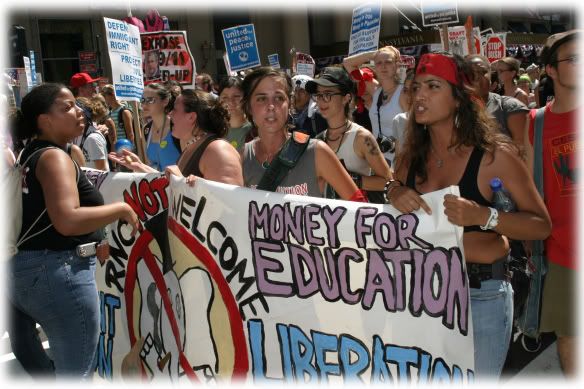
Date Created 04 Jul 2008
Monday, September 1, will be a day of civil disobedience and direct action to shut down the opening of the Republican National Convention (RNC) in Minneapolis-Saint Paul. Pittsburgh Organizing Group (POG) will join these actions in opposition to a two-party system incapable of meeting basic human needs that is bankrupting and decimating our communities through a culture of war and fear.
The RNC Welcoming Committee (RNC-WC), a Minneapolis-Saint Paul-based group, has been publicly organizing to shut down the RNC through a three-tiered strategy of blockades. Dividing downtown St. Paul into seven sectors, the RNC-WC is asking groups to adopt an intersection or sector. POG has decided to coordinate blockades for Sector 1 and shut down the intersection at 7th and Wall St. We invite you to join us in Sector 1 on that day.
Why Shut Down the RNC?
Many rightfully point out that this convention is a spectacle since the result is already a certainty. This is a coronation, not a decision-making event which outsiders can influence. If we shut it down, they could always meet a week later in a secluded location. However, this is exactly why and what we're protesting.
The current system doesn't survive because of a decision made by a party or politician. It doesn't survive because parties calling themselves "The Republicans" or "The Democrats" say they represent the people. It survives because of corporate control of the means of mass communications that limit the scope of the political discourse. It survives because people give the system "legitimacy" through their participation (with activities such as voting) and refusal to demand more. It survives because it prevents the rise of-and has successfully delegitimized-alternative means of decision-making in the popular imagination. In the end, people have few choices on a limited set of questions that never get at the root of where power rests. This is not enough. Our goal isn't to push a more centrist or even a more liberal candidate. It isn't to strengthen government power in the hopes that can curtail corporate power. Nor is it putting into power a new brand of left-wing elites. Our aspirations are to change the fundamental structures of society to decentralize power and decision-making so all those impacted by a decision have a say in its outcome, to change the economic question from "what is profitable?" to "what is necessary, desirable, and sustainable?" and to expand the concept of liberty and the pursuit of happiness from simply "freedom from" to include "freedom to."
Conventions, elections, and debates are events that promote the false idea that people are freely participating and freely choosing who best represents them. They mask who has power and obscure the reasons why certain people have power. In this way, the RNC and DNC represent the idea that it is legitimate for John McCain and Barack Obama to be the only realistic choices to head a vast hierarchy ruling over the lives of hundreds of millions of people and affecting the lives of billions.
The positive result of shutting down the Republicans' convention, much like shutting down a trade agreement summit, does not primarily reside in the decisions that were delayed or the meeting that couldn't take place. It is in the loss of legitimacy the institution suffers as it becomes controversial and alternatives demonstrate popular support. It breaks a cycle of propaganda that has lulled people into believing "the way things are" is natural, desirable or inevitable. It reaches out to the half of the population that chooses not to participate in electoral politics to say, "There are people searching for something different and we need your voice." It reaches out to the other half that does participate to say, "We know why you vote. We know that who rules us can be life or death within this system. But we also know that our future rests in figuring out how to break out of the trap of accepting bad rulers for fear of getting worse rulers."
The change we can believe in lies in direct, participatory democracy, built on strong social movements that oppose interconnected oppressions and expand individual and collective freedom at the expense of the forces, government and corporate, curtailing it. We believe that in this desire for true freedom and true democracy, we have much in common with the people of Minneapolis and St. Paul and very little in common with the John McCains and Barack Obamas of the world.
POG's Role in the RNC-WC Strategy
Over the past year, the RNC Welcoming Committee has worked with people from all over the country to create a strategy for shutting down the RNC. The result was a three-tiered strategy of blockades, the division of St. Paul into seven sectors and a plan for blockading known as the "3S Strategy" (Swarm, Seize, Stay). With this in mind, the RNC-WC has called for groups to adopt sectors and to block intersections. POG has decided to adopt Sector 1 and organize a congestion blockade at 7th and Wall. As articulated by the RNC-WC, adopting doesn't mean POG is blocking all the intersections in our sector, nor are we assuming responsibility for recruiting and ensuring other groups do so, it simply means we're making ourselves available as a point of contact for groups interested in operating in Sector 1. In this way, we will provide an open avenue for participation, and help disseminate information and coordination.
We will announce a Sector 1 launching point, place and time later this summer. In conjunction with the RNC-WC, we will organize a Sector 1 spokescouncil meeting the weekend before the actions. On Sept. 1 participants will collectively swarm the sector, seize key intersections and hold them for as long as possible.
We hope this call will provide an inclusive way for others to participate in the action and help build the success of the mobilization. We see a public gathering point as important for groups to utilize for their planned actions and it provides an easy way for smaller groups and individuals to plug into the actions. Through clear articulation of our underlying motivations and goals we hope to dialogue with other groups and the general public about why and what we're protesting.
At the 7th and Wall congestion blockade, we will collectively resist any attempts to dislodge the blockade through our numbers and determination. Though we hope to avoid it, participants should understand this action has the risk of arrest and the possibility of police violence. In addition to the normal police arsenal of weapons, the Twin Cities have recently passed new protest laws restricting the rights to assemble. A chart of the new policies is available here.
We are working on how to facilitate an initial gathering point for groups operating in Sector 1 and will post updates on our website. Regardless of assembly restrictions it's important not to let other sectors down. Groups should be prepared for the possible necessity of reaching their intersection alone. Plan accordingly.
To Get Involved with Sector 1 "Direct Action for Direct Democracy":
If your affinity group or organization is interested in publicly endorsing this call, participating in the blockade of 7th and Wall, or blockading another intersection in Sector 1, contact us at rnc@organizepittsburgh.org to coordinate.
As we've already mentioned, not all the information is available yet. We will be releasing another call closer to the action. Check our website at www.organizepittsburgh.org/rnc to keep up with updates and get information on our plans and the situation in Sector 1.
For the official call to action and other info see www.rncwelcomingcommittee.org.
Thursday, July 10, 2008
THE NATIONAL ENDOWMENT FOR DEMOCRACY: NEOLIBERAL VS. PARTICIPATORY DEMOCRACY

By James Jordan
Source: http://www.politicalaffairs.net/article/articleview/7046/1/340/
Haven’t heard of the National Endowment for Democracy? Not many people have. Yet the NED is taxpayer funded and carries out foreign policy with no meaningful public oversight or transparency. In fact, it does more to undermine democracy than not.
The NED…
* …spent more than $20 per voter in Nicaragua in 1990--more than had been spent by both candidates in the 1988 US Presidential election!
* …funded and set up meetings between organizations involved in the 2002 attempts to overthrow the elected government of Venezuela.
* …funds far right parties in Eastern Europe, even working with convicted Nazi collaborators like Lazslo Pasztor, of the NED funded Free Congress Foundation.
* …funded, created, and trained most of the groups involved in the overthrow of Haiti’s elected government in 2004, through its core institute, the International Republican Institute, chaired by John McCain. This led to the bloodiest year in Haiti in modern history.
* …spends almost half its budget in support of the occupation of Iraq.
Here in the United States, we care about democratic rights. We fought a revolution against colonialism and we fought a civil war against slavery. In the 20th century we fought for women’s right to vote and we waged a civil rights struggle to secure the vote for people of all ethnicities. We were knocked down a few times when we got a president, in 2000, who actually lost the popular vote, only to turn around and force us into a war that the US people didn’t want. But we’re still here, still struggling on behalf of real democracy!
We care about democracy—at home and elsewhere. Unfortunately, the political-corporate-military machine tries its best to keep us from learning about US efforts to undermine elections in other countries. These efforts are aimed at making sure other governments adopt policies granting easy access for big corporations to natural resources, cheap labor, and new markets. This is backed up with US military power. Michael Plattner, a vice-president for the NED, explains, “Liberal democracy clearly favors the economic arrangements that foster globalization ….The international order that sustains globalization is underpinned by American military predominance.”
While the NED is only a small part of the US so-called “democracy promotion” efforts, its influence reaches far beyond its annual budget.
The NED is…
1) …Unconstitutional–
* The NED sets a dangerous precedent by privatizing US foreign affairs. The constitution is clear that international relations are carried out on behalf of the US people by the executive and legislative branches.
2) …A “Black Box” of Democracy Interference that violates the public trust–
* Because of it’s publicly-funded, yet “private” character, the NED is not subject to any meaningful oversight. In fact, the core institutes of the NED also receive funding from USAID and the US State Department. Funneled through these institutes, and then further subcontracted, even non-NED funding can get laundered so that it is almost impossible to track.
3) …A web of military, political, espionage, and corporate media that obstructs the free flow of information for the sake of corporate interests–
* The boards of the NED and its core organizations are full of Spin Doctors from public relations firms, big advertisers, corporate headquarters; political analysts and advisors; and ex-CIA and military personnel. Vin Weber, NED Board Chair, works for a public relations firm that is part of the Omnicom Group, the world’s 3rd largest advertising agency. The Center for International Private Enterprise, an NED core institute, includes an executive from Google and a major contractor with Google. The International Republican Institute, another NED core institute, includes a former Senior Advisor to the CIA and various representatives from the military-industrial complex. These are just a few examples. The NED is able to coordinate campaigns of misinformation and bring together a diverse coalition in order to manipulate foreign elections. If that fails, the NED empowers that coalition to overthrow elected governments—like it did in Haiti and like it is trying to do in Venezuela.
The sole mission of the NED is to “fix” other countries’ elections, and most US residents would agree that is unfair. USAID also builds schools, roads and has other projects that are an obligation for rich countries to provide to the poor countries since our wealth was extracted from them in the first place. The NED mission, on the other hand, is limited to the manipulation or other countries’ democratic institutions and processes.
In the playing field of democracy, two competing forms have met head to head: neoliberal vs. participatory democracy. The kind of democracy that the NED favors is the neoliberal kind. Its proponents, such as Plattner, refer to it as liberal democracy, but that is incorrect terminology. Liberal democracy is the philosophy of government on which the US was originally founded. It is flawed, but still more democratic than its neoliberal permutation. One still has had to struggle pretty hard to win the right to vote, be it through colonial revolt, civil war, or suffragist and civil rights movements. But once the less-than-assured right to vote is won, elections are more or less decided along the lines of “one person, one vote” and “majority rule.” Another goal of real liberal democracy is the protection of minority rights. But the only minority neoliberal democracy aims to protect are the rights of big corporations.
Neoliberal democracy replaces the motto of “one person, one vote” with “one dollar, one vote.” For instance, in Iraq, the US is advocating for passage of oil laws that are opposed by two thirds of the Iraqi population. Passage would result in the biggest give-away of oil profits that the Middle East has witnessed. Union membership in the oil and public sector was also outlawed by the occupation government.
Conversely, participatory democracy directly empowers community structures and cooperative ventures. When I think of participatory democracy, I think of Susana and Cesar Achique, from Tacaraigua de la Laguna in Venezuela. Susana Achique is the elected president of the Grupo Turismo y Aventura Dios y Yo (or, the God and I Tourism and Adventure Group), a local coop that was founded on a government credit of just under $140,000 US dollars. With that money, they bought and outfitted three motor boats, an office and launching dock, and set up a cooperative that takes tourists on ecological and fishing trips.
Cesar, the driver and tour guide for our boat, was enthusiastic, telling us how their lagoon had been damaged by over-fishing by commercial trawlers, depleting both fish and bird populations that depend on the fish for food. Jobs were scarce—the commercial fishing industry brought the town little benefit. Cesar’s eyes radiated a confident pride as he told about the return of the fish and bird populations following the Venezuela’s reform of fishing laws that stopped the trawlers from entering such environmentally sensitive areas. As if to underscore what he was saying, thousands of birds started their evening descent into the mangrove swamps around us as the sun began to set.
Back on shore, Susana explained to us how members run the coop democratically. Profits from the venture are used to pay the workers and to provide community benefits. This is something I heard over and over in Venezuela—how coops and worker owned and operated factories don’t just benefit the people directly involved, but the whole community. Revenues fund schools, health clinics, and more. Media centers, food subsidy centers, health clinics, and a whole variety of government missions are not just serving but are being implemented by community members.
While Venezuela is engaged in a massive effort to diversify its economy, it still remains dependent on oil profits which, under participatory democracy, support social spending. Community members are involved in decisions about whether or not to develop oil resources and, for the first time in Venezuelan history, indigenous nations most affected by oil development, take part in these decisions.
Has participatory democracy been good for Venezuela? Since the people gained popular power in 1998, the poverty rate has dropped from 54% to 38.5%--30% if food and health subsidies are factored in; millions have gained access to free health care; half the population is enrolled in free, public education; and over 5 million acres of fallow land have been turned over to rural people for agricultural development. The economy has been growing steadily since NED funded attempts to overthrow the government in 2002.
The Alliance for Global Justice has begun a project called the Respect for Democracy Campaign, and one of our primary goals is to close the NED. This campaign has been endorsed by many groups and individuals, including Howard Zinn, author of the Peoples’ History of the United States, Eva Golinger, author of The Chavez Code and Bush Vs. Chavez, Rev. John Fife, co-founder of the Sanctuary Movement and former Moderator of the Presbyterian Church USA, the Venezuela Solidarity Network, the Campaign for Labor Rights, the Worker to Worker Solidarity Committee, and the Nicaragua network.
Of course, ending democracy manipulation and winning participatory democracy must be built upon participatory struggle! In other words, what this campaign needs is…YOU!
Neoliberal democracy and economics has put the future of the world at stake. We have a choice: corporate globalism and elitist power or community autonomy and people power.
Which of these is in YOUR future?
--James Jordan is coordinator of the Respect for Democracy Campaign. For More information: www.respect4democracy.org. Email: respect4democracy@afgj.org. Phone: 202-544-9355.
Monday, July 7, 2008
e-VotingBooth.com: VOTE TO HOLD OIL COMPANIES ACCOUNTABLE FOR OIL PRICES ON THE WEB

Welcome to the website that puts Democracy in Your Hands!
How? By allowing you to “vote” on every single piece of legislation being considered by Congress. You can even add your own comments with your vote. Then, e-VotingBooth provides the “election results” to every member of Congress and the President before the Final Bill Vote in Congress.
e-VotingBooth drastically changes the mental calculus of Congressmen and the President of how to vote for a bill. e-VotingBooth adds a new voice, YOU, to their voting consideration and e-VotingBooth gives you significant power with your Congressmen and President.
You have power because e-VotingBooth tracks every vote you make, and our first site upgrade (coming soon) will provide your elected officials’ votes alongside yours for comparison. At any time you will see how they voted on each bill you voted. This will be particularly useful right before elections. For example, if you find a Representative, Senator or President voted against you 90% of the time you are far more likely to vote against him or her for re-election than if they had voted 90% with you. Now your elected officials are highly motivated to consider you and your neighbors’ votes—or suffer the consequences.
In essence, e-VotingBooth allows you to participate in the legislative process of the United States of America and easily track how your elected officials are serving you.
E-VotingBooth provides you with information to make an informed position on whether to allow them to continue working for you (their re-election fate). So dive in and be an active participant in the legislative process of the United States of America.
Vote to hold oil companies accountable for oil prices on the Web
June 29 2008
Source: http://cnewspubs.com/elections/modules/news/article.php?storyid=679
If you are tired of paying more than $4 per gallon for gasoline take action now: vote on U.S. Senate Bill 3044 on e-VotingBooth.com.
The Consumer-First Energy Act of 2008 is designed “to provide energy price relief and hold oil companies and other entities accountable for their actions with regard to high energy prices, and for other purposes.”
“e-VotingBooth.com is the only website where all Americans can vote on any pending bill in Congress,” said Steve Thompson, founder and president of e-VotingBooth.com, “converting the United States from a republic to a direct democracy. The site allows America to switch the focus from the individuals we elect to the legislation itself.”
Americans can vote at any time on any bill (once introduced), they're not tied to the voting schedule of any bill. They can even vote bills already enacted.
“While Americans have historically been able to write their Congressman or President, these actions are relatively diluted because they are only contacting individuals,” Thompson said, “whereas voting on e-VotingBooth.com aggregates every single American’s vote in that one respective bill, amplifying their power.” No other action is faster, easier or more effective than pulling up a bill and voting in e-VotingBooth.com.
e-VotingBooth.com is a non-partisan, private and veteran-owned company that assumes a fiduciary responsibility to provide this “public trust” as the only tool for all Americans to participate in the legislative process of the U.S. Congress. “We also believe e-VotingBooth.com is the perfect tool for all organizations and individuals who wish to remain neutral or apolitical, yet encourage their members to participate in the governance of our country,” said Thompson.
Sunday, July 6, 2008
CONNECTICUT: CONSTITUTIONAL CONVENTION?

July 4, 2008
In a sissy Northeastern state such as Connecticut, there are dozens of issues considered too icky to be discussed by the General Assembly.
The legislators say a little prayer each night, begging that abortion stuff and same-sex marriage stuff and English-as-the-official-language stuff and anti-affirmative action stuff and lots of other, well, icky stuff never comes up — or at the least, never prompts a public hearing at which the Great Unwashed can go on and on about stuff that is simply too icky to imagine.
On the other end of the legislative agenda are things so obscure that one questions whether the Founding Fathers should have bothered risking their lives to free us from British cuisine. The state flower, the state lizard, the state cantata — the legislators live in fear that some third-grade class will champion such stuff and they will be forced to vote up or down, perhaps being pressured to support the wrong lizard or, in the alternative, crushing the spirit of youngsters participating in the legislative process.
One strategy to relieve all this angst would be to establish an initiative and referendum process at the state level, empowering the citizenry to express themselves directly on all manner of icky and obscure stuff — and thus freeing legislators from the horror of divining the public good.
This November, as we march to the polls to decide once and for all whether Barack Obama is the Messiah or merely a kid with a good speechwriter, we will also vote on whether to hold a constitutional convention in Connecticut, to consider, among other things, an initiative and referendum process that would empower us all to throw off the tyranny of third-graders and pick our own darn state lizard.
Depending on who is doing the counting and defining the terms, about half the states have some kind of direct-democracy process by which voters can express themselves. South Dakota was the first state to adopt such stuff, in 1893 — and the idea caught on in "progressive" circles as a populist tool to tame the railroad magnates and bankers and newspaper publishers and other stuffy rich people who presumably controlled the state legislatures.
Today, the initiative and referendum process is considered more the tool of conservatives than "progressives" — a process by which the voters can rise up and smack the tax-and-spenders or the trendy social liberals. Although the referendum process is already in place in some Connecticut towns, efforts to establish a system for state government have never gotten very far in the legislature. The boys and girls in Hartford, most of them safe in carefully drawn voting districts that ensure their re-election forever, are happy with the current system, except for the lizard stuff.
The current political and governance environment suggests that Connecticut would be the last state in the union to ever approve a referendum process. With the Democrats in control of the legislature forever, and with voters canny enough to never elect a Democratic governor, the shaky equilibrium offers up slow-and-steady, mildly destructive public policy that fits the bland political personality of the state.
Initiative and referendum suggests uncertainty, instability, encroachment on the powers of the well-connected. If direct democracy ever came to a real vote in Connecticut, even the chamber of commerce types and the business associations that pretend to be grouchy about high taxes would come out against it.
The taxpayer advocacy groups and other fiscal hawks in Connecticut would march in the streets for direct democracy, thus prompting the teachers unions and social-service crybabies to recruit armies of naysayers to protect their tax-and-spend hold on the General Assembly.
If, through some miracle, a referendum system ever did make it onto a ballot for voter consideration, the Connecticut compromise machine would be working overtime. There would be an "emergency" escape clause that would make the referendum decisions toothless — and the petitioning process would be made unnecessarily onerous, so as to discourage all but the most avid fans from launching a tax-cutting orgy of ballot questions.
By the way, Cohen should be named "State Columnist." Think about it. Prepare the petitions. The time is near.
Laurence D. Cohen is a public policy consultant who served as special assistant to former Gov. John G. Rowland. His column appears every other Friday. He can be reached at cohencolumn@aol.com.
Thursday, July 3, 2008
MIKE GRAVEL'S CAMPAIGN FOR DIRECT DEMOCRACY
 Mike Gravel works hard to promote direct democracy and make the concept common public knowledge. Fighting against mainstream media and stagnated Washington politics, his goal is revolutionary. We salute his dedication and determination to make direct democracy a household term, it is going to take a whole lot of us to get his sort of initiatives rolling. -Editor
Power to the People
Mike Gravel’s campaign for direct democracy
BY MAX NEWMAN-PLOTNICK
Source: http://hprsite.squarespace.com/power-to-the-people-042008/
Mike Gravel served two terms as a U.S. Senator from Alaska from 1969 to 1981. Currently a candidate for the Democratic nomination for the presidency, he sat down with HPR to discuss what he considers to be the most important issue facing America: his National Initiative, a plan to implement a form of direct democracy through federal ballot initiatives.
HPR: You were the first person to file your candidacy for the Democratic nomination. But in the last half of 2007 you started getting excluded from debates and your campaign isn’t getting much coverage. Given this, how effective has your campaign been in promoting direct democracy?
Sen. Mike Gravel: It’s been more effective than I realized. It’s very hard; we’re talking about something that’s totally out of the box, politically. I got more press for the National Initiative in the first week of my candidacy than I had in the ten years before that. But when you’re talking about something that people are not acquainted with, you have to repeat it over and over again. Now what had happened in the campaign was that the Democrats, and then corporate America, immediately wanted to marginalize me. Not so much because of the National Initiative, because I don’t think they understand it at all, but because I took a very strong position on the war and pushed the other candidates in that direction. I told the Congress how to end the war and gave them the procedures on how to do it. That disturbed them. Then when I challenged them over the military-industrial complex and how the country has been sold out, that disturbed them.
But, after the Texas and Ohio primaries, the media has got to have some grist for the mill, which is going to give me an opportunity to get my message out, and that’s why I continue to run. After the convention, obviously I won’t have the nomination, but maybe another party would want to pick me up as their standard bearer going into the next election. There are five blind polls that I know of that show that on the issues I am far and away ahead of all the other candidates. If the American people knew who I was, with respect to the issues, I would become president.
HPR: Would you say that the National Initiative is the most important issue of your campaign?
MG: It’s not only the most important issue of my campaign, it is the most important issue in the history of the country since it’s founding. There are twenty-four states that have initiative laws where people can make laws at the state and local level. But those laws are very inadequate. It should apply in every government jurisdiction in the United States. In the twenty-four states that have this, it is controlled by representative government. I want it to be independent of representative government. And how we do that is by having the electoral trust created, which will administer the procedures on behalf of the people.
HPR: So you see the National Initiative as being a fourth branch of the government, providing checks and balances?
MG: Very much so. In fact, it becomes the fourth check. And that’s very significant, because if you have one party controlling all three branches of government, you have no checks. And keep in mind, under our system, which has been so corrupted, the two political parties, Democrats and Republicans, which are not mentioned in the Constitution, are more powerful than the executive, the judicial, and the legislative branches. It’s a monopoly. And how do you break that monopoly? You can’t. Not within the context of representative government. That’s why I decided to go around the government and enact this law to allow the people to become lawmakers.
HPR: How do you get the necessary political power to pass these measures?
MG: By turning around and having a private non-profit corporation conduct a national election, and getting sixty-million Americans to vote for it. When this happens it will become the law of the land. The founding fathers all agreed that the people were sovereign and the first amendment gives the people the right to express their opinion and petition the government. What is an election but this?
For more information regarding the National Initiative and Sen. Mike Gravel, see his site: http://www.gravel2008.us/
Tuesday, July 1, 2008
DIRECT DEMOCRACY MAY NAME SEWAGE PLANT AFTER PRESIDENT GEORGE W. BUSH
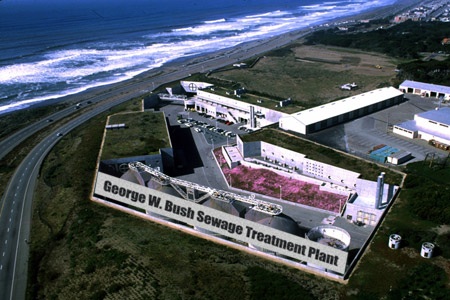
Satire at the ballot box to 'honor' Bush
Marisa Lagos, Chronicle Staff Writer
Tuesday, June 24, 2008
Source: http://www.sfgate.com/cgi-bin/article.cgi?f=/c/a/2008/06/23/MNPQ11A3T7.DTL
(06-23) 18:49 PDT -- If you've attended an event or festival in San Francisco lately - or even just hung out at a city park - you've probably seen them.
Admittedly, they're hard to miss. Someone in the group is usually toting a large American flag, and another is often carrying a boom box blaring patriotic music. Sometimes one of them dresses up as Uncle Sam.
They're the Presidential Memorial Commission of San Francisco, but don't let the serious name fool you. The group's intentions are in the gutter: They want to rename the Oceanside Water Pollution Control Plant the George W. Bush Sewage Plant come January, when the next president is sworn in.
During the inauguration, the group also wants supporters to participate in a "synchronized flush"- a way to send a gift to the renamed plant, which supporters say, would be a "fitting monument to this president's work."
It sounds like a harmless joke, or maybe a college civics lesson gone awry. But the handful of friends who dreamed this up over beers one night say they have already collected 8,500 signatures in support of the plan - 1,300 more than the minimum needed to put the question to city voters in November. When they submit the signatures in July, election workers will have to verify that at least 7,168 are from registered city voters for the measure to qualify for the ballot.
"It's a very simple yes or no question, and there's no real fiscal impact- just the cost of relettering the sign in front of the plant," said organizer Brian McConnell. "This is the way the democratic process is supposed to work, even though it's a silly idea in some people's eyes."
Silly might be an understatement. Howard Epstein, chair of the San Francisco Republican Party, called the measure an abuse of the system and "loony bin direct democracy." He vowed to "use all means" to defeat the measure if it qualifies for the ballot. That includes those very expensive glossy mailers, he said.
"There's no use other than to make these nutcases feel good," Epstein said. "It's typical San Francisco crazies."
Still, most people approached on a recent Sunday seemed open to the idea, even if they all didn't stop to sign the petition.
Bright Winn, a San Francisco plumber, enthusiastically gave his signature to the cause.
"(Bush) has always done well for the affluent of America, and anyone that does well for the affluent should be named for the effluent," he said.
The idea behind the renaming runs the gamut from the humorous ("Clean up the mess caused by Bush!" one supporter shouted ) to the sarcastic ("No other president in American history has accomplished so much in such a short time," the group's Web site reads) to the philosophical.
Satire, McConnell said, is one of the great American traditions.
"Fifty years from now in a civics class, students will learn about the Lincoln Memorial, that other presidents are on Mount Rushmore - and George W. Bush got a sewage plant," he said. "It will prompt people to ask why, and they can discuss the Iraq war, and everything that led to it. People want to forget bad moments of history, and this is our way of making sure that doesn't happen."
To be fair, there are already other tributes to President Bush, including a Stockton elementary school and, of course, the presidential library planned in Dallas.
Organizers of the petition drive believe the measure will pass, noting that 2006's Proposition J calling for the impeachment of Bush and Vice President Dick Cheney passed with 58 percent of the vote.
The biggest opposition in this Democratic stronghold, McConnell said, is people who oppose naming anything after the 43rd president.
Officials at the San Francisco Public Utilities Commission, which owns the plant, say they get the humorous intent. But they note that the plant is an award-winning facility that keeps the city's streets and the ocean clean.
"If you are looking for a place to make a negative statement about the Bush administration's impact on the environment, this would be the last place to do it," agency spokesman Tony Winnicker said.
Find out more
For more information about the Presidential Memorial Commission of San Francisco: presidentialmemorial.wordpress.com.
E-mail Marisa Lagos at mlagos@sfchronicle.com.
This article appeared on page A - 1 of the San Francisco Chronicle


