

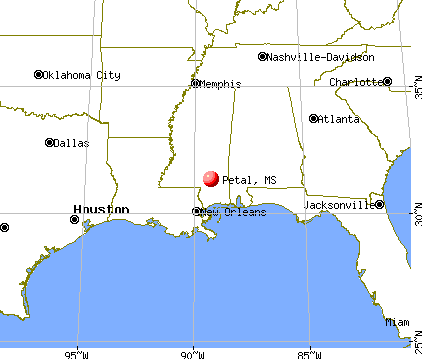
Petal residents help make changes
From staff report • August 8, 2008
Source: http://www.hattiesburgamerican.com/apps/pbcs.dll/article?AID=/20080808/OPINION01/808080356
A comment that Petal Alderwoman Liesa Weaver made during Tuesday's board meeting attracted our attention. The board was discussing a zoning change for an 18-acre site off Hillcrest Loop from residential to planned urban development, which would have opened the area to a mixture of apartments, business, town homes and estate homes.
The board voted 4-1 to deny the zoning change to the relief of several residents of the area concerned that their peaceful neighborhood would be changed for the worse.
"I feel threatened by crime and noise, but from an intrinsic point, I want my peace of mind and safety," said resident Richard Storey.
Weaver was among the board members voting to deny the rezoning.
"If all of you had not come up here and been calling me this week, I would be voting for this," she told residents attending the meeting to see what would happen. "I listen to the people in this community."
It's a perfect example of participatory democracy. The leaders listen to all sides of an issue and then vote for what they believe is the best course. The fact that the residents got involved in this issue speaks well of them.
We wish more people would take an active interest in their local, state and national government. Especially on the local level, individuals can make a difference.
This isn't to say that Alderman James Moore, who cast the lone dissenting vote, was wrong. He said he thought the zoning change meshed with the city's Smart Growth plans. He obviously listened to the residents and took what he thought was the best course.
We think in too many towns and counties, those who are governed allow their leaders to make decisions that in the long term cause irreparable harm to communities.
CLICK ON YOUR STATE FOR CURRENT BALLOT MEASURES - COURTESY OF BALLOTPEDIA
Friday, September 5, 2008
MISSISSIPPI: SMALL TOWN CITIZENS ILLUSTRATE THE VALUE OF POLITICAL PARTICIPATION


Thursday, September 4, 2008
THE ROLE OF THE MEDIA IN A PARTICIPATORY DEMOCRACY

Why is Sam Zell the new whipping boy for crusaders who think corporate media still sucks?
By Michael Miner
August 7, 2008
Source: http://www.chicagoreader.com/features/stories/hottype/080807/
I admire a gallant crusade as much as the next guy, but StopBigMedia.com has the ring of an army raised to fight the last war. Why should anyone in Chicago take up arms against big media when big media’s already falling apart on its own?
“Dear Friend,” began the e-mail blast StopBigMedia.com sent out in July. “When members of Congress from your state return home this summer, they need to hear why stopping further media consolidation must be a top priority. By acting now, you can ensure that there are thousands of petitions ready to be delivered when your U.S. representative sets foot back in your district for the summer congressional recess.”
StopBigMedia.com wants the House to do in the fall what the Senate did in May: vote to overturn a 2007 Federal Communications Commission action ending the ban on common ownership of broadcast outlets and newspapers in a single market. The campaign calls the FCC’s new policy “nothing more than a massive giveaway to Big Media.”
And who’s the new Big Media bogeyman? Despite the vastness of the News Corporation and its recent consumption of the Wall Street Journal, Rupert Murdoch seems to have ceded the position to Chicago’s own Sam Zell. Zell’s new, he’s fresh, he’s a loose cannon, and he sounds dangerous.
StopBigMedia.com is run by Free Press, a Washington-based “national, nonpartisan organization working to reform the media.” Rooting around its Web sites, StopBigMedia.com and freepress.net, I came across a video link to a speech Bill Moyers gave at the National Conference for Media Reform, presented by Free Press in June in Minneapolis. It was, as Free Press executive director Josh Silver puts it, “vintage Moyers.” And Moyers couldn’t resist going off on Zell.
“I believe more fervently than ever that as journalism goes, so goes democracy,” said Moyers. “Yet as mergers and buyouts change both old and new media, bringing a frenzied focus on cost cutting while fattening the pockets of both the new owners and their investors, we are seeing journalism degraded through the layoffs and buyouts of legions of reporters and editors. . . . The new owner of the Tribune Company, real estate mogul Sam Zell, recently toured his new property, the Los Angeles Times newsroom, telling his new employees the challenge is, ‘How do we get somebody 126 years old to get it up?’ Well, said Zell, ‘I’m your Viagra.’”
Given the flaccid state of the Tribune Company, I thought as I watched the video, a little Viagra might be just the thing. Maybe Moyers’s listeners had the same thought. They tittered lightly—he would have to work harder for his laugh.
“I’m not making this up,” he added. Adequately cued, the crowd chortled.
“He told his journalists that he didn’t have an editorial agenda or a perspective ‘about newspapers’ roles as civic institutions,’” Moyers continued. “‘I’m a businessman,’ he said. ‘All that matters in the end is the bottom line.’ Just this week Zell told Wall Street analysts that to save money he intends to eliminate 500 pages of news a week across all of the company’s 12 papers. That could mean eliminating some 82 pages a week just from the Los Angeles Times. What will he use to replace reporters and editors? He says, to the Wall Street analysts, ‘I’ll use maps, graphics, lists, rankings, and stats.’ It sounds to me as if Sam has confused Viagra with Lunesta.”
What is it about Zell? I asked Josh Silver. “He insults journalists and journalism at virtually every whistle stop on his tour,” Silver replied, referring to Zell’s visits to Tribune Company properties. “He says it’s not about democracy—it’s about profits. The American public and policy makers have to decide whether journalism is produced purely for the reaping of profit or if it’s a central component to a functioning participatory democracy.
“And based on the answer to that question,” Silver went on, “you make policy accordingly. There is no such thing as a deregulated media policy system. The only question is, will the media be regulated for the largest media corporations or regulated on behalf of the American public. That’s what all of our anticonsolidation efforts are about.”
If Zell would shut up, critics like Silver and Moyers might notice that he makes a lousy poster boy for big media. He took the Tribune Company private and made its employees nominal co-owners. He’s not acquiring properties—he’s selling them off. America has always had it both ways about that choice Silver thinks the nation needs to make: journalism for profit or journalism for democracy. Zell has loudly and rudely told his staffs that from where he sits the second is predicated on the first, and turning a profit is something he knows a little more about than they do.
But I don’t want to suggest Free Press can’t see beyond Sam Zell. In his welcoming address at the Minneapolis conference, Silver hailed the “movement” and said it stands “on the brink of the greatest opportunity in generations to break the corporate media stranglehold on democracy.” He explained, “The future will go down one of two paths. The first is the righteous path. It’s of openness—a new media world that treats all content equally. . . . The second path is a closed Internet—an Internet that looks like radio, TV, or cable, an Internet where giant phone and cable companies decide what’s on, how much it costs, and how fast it downloads, an Internet that is no longer a vibrant town square for all of us but a cash cow for a few.”
And so “we dedicate ourselves here today to the proposition that our fight for a democratic, open Internet and independent media will end the historic pattern of monopoly that suffocates freedom, dissent, and creativity.”
Those are Silver’s concerns, and though I might put them a little less grandiosely, I share them. The Free Press Web sites are a handy gateway to media analysis, some of it more soberly phrased. On freepress.net I came upon a link to a transcript of a July 29 panel discussion on Democracy Now! on the sorry state of the newspaper industry. This time Zell got a sliver of sympathy. Bernard Lunzer, president of the Newspaper Guild, said there’s “a lot of fear, almost a sense of panic,” at American papers as stocks tumble and staffs are slashed. Part of the problem is that the companies were “addicted” to huge profit margins, Lunzer said, but he allowed that in Zell’s case and some others “they paid too much, they’re overleveraged, there’s too much debt.”
Lunzer said he understands that newspapers must reinvent themselves. “There has to be innovation,” he said. “We’ve been willing to bargain concessions where necessary, but we think the biggest mistake is that the owners and the publishers have not been talking to the frontline workers about that kind of innovation. So, what we’re trying to do, where we have to do concessions, we want to trade that for real involvement, real committees that are able to work on a better business model, on the future of the product. We still believe that there’s a place for quality journalism, that people will want it.”
(To which Lee Abrams, who’s Zell’s “innovation” czar, might reply: We believe that too and we’ve formed those committees. We’re not only asking the frontline workers for innovative ideas, we’re begging them.)
Lunzer hopes Zell, who’s already sold Newsday, will unload more papers to get them out from under that crushing debt. “We’re hearing that Tribune Company is going to save journalism through all these cuts,” he said. “That’s not what we’re seeing. That’s not what we’re feeling. We’re feeling that basically it’s just a self-fulfilling cycle of a downward spiral.”
Josh Silver focuses on mainstream media because that’s where both the money and the serious journalism still are. “The overwhelming majority of stories are broken by professional journalists, not by bloggers or armchair amateurs,” he told me. But the Internet is irresistible, and Moyers in his speech warned that the “clock is ticking.” He said, “Advertisers have already aggressively seized the new online world to go back into the programming business themselves, creating what’s called ‘branded content.’ Imagine the Camel News Caravan revived, but this time as a sponsored YouTube channel. Can you imagine advertisers going for stories with key words such as ‘health care reform,’ ‘environmental degradation,’ ‘Iraqi casualties.’ . . . I don’t think so. So what will happen to news in the future, as the already tattered boundary between journalism and advertising is dispensed with entirely, and as content, programming, commerce, and online communities are rolled into one profitably attractive package?”
But how alarmed should we be by this? Why shouldn’t advertisers exploit key words? They’ve always directed their ad dollars at the programs and publications that best deliver the specific audiences they covet. What degree of specificity turns that into a sin?
We need to pick and choose among our worrywarts. I’m more in tune with Chris Hedges, a former New York Times reporter and another of the Democracy Now! panelists. Hedges said dourly that “the large newspapers are dying, and the Internet is not going to replace them.” He said Times stock has dropped and it’s gone through its own rounds of layoffs and buyouts, and although “part of it is ownership, part of it is just the antiquated nature of newsprint as a conveyor of information.”
Hedges repeated himself for emphasis. “It’s not totally about ownership; it is about the medium itself. The average reader of the paper copy of the New York Times spends 45 minutes reading the paper. The average viewer of the New York Times Web site spends about 7 minutes. The Internet is not designed for a literate society. We are moving into a postliterate society.”
Tuesday, September 2, 2008
THE PARTY CRASHERS: DIRECT DEMOCRACY IN THE STREETS

The Party Crashers
By Michael Gould-Wartofsky
The Nation Magazine
August 19, 2008
Source: http://news.infoshop.org/article.php?story=20080820143334877
At some point during the upcoming Republican National Convention, delegates will look out the windows of the Xcel Energy Center, or down from swank hotels and grand old after-parties, and there, past the security fences and the legions of taser-toting police and private security guards, they will see the other America spilling into the streets of St. Paul, Minnesota.
That is, if the Republicans even make it that far. From September 1-4, the RNC will be besieged by a panoply of protesters--including antiwar activists, Iraq War veterans, Hurricane Katrina survivors, immigrant workers, labor unionists, anarchists, environmentalists, feminists and queers. At the frontlines will be America's young dissidents who will walk out of class, lock down intersections and dance in the streets to "Funk the War."
The view from Denver at the Democratic National Convention at the end of August will look a little different. That's because in the age of Obama many of these same movements, so united against the RNC, are deeply conflicted over the Democrats and the party system itself--perhaps none more so than the youth movement. At issue, say organizers across the country, is not only their relationship to the Obama campaign and the presidential elections but the very meaning of democracy in 2008. Is true democracy possible inside the party system and on the campaign trail? Or is democracy to be found and made by the people in the streets outside? Will the two ever meet?
Not if the conventioneers have their way. Uncredentialed activists are to be fenced off and kept away from the Pepsi Center in Denver by parking lots the size of football fields. The protesters descending on the RNC will be cordoned off into designated "free speech zones," guarded by thousands of police officers to the tune of $50 million at this "National Special Security Event."
The streets will also be haunted by the ghosts of conventions past, from the cracking of skulls at the 1968 Democratic convention in Chicago to the pre-emptive arrest and detention of nearly 2,000 protesters at the 2004 Republican convention in New York City. Like their predecessors outside those arenas, this year's dissidents have come to see the party conventions, advertised as the ultimate showcases of American democracy, as exhibits A and B of the nation's deficit of democracy instead. And they cast themselves in opposition, as the keepers of the flame.
"It really will be a collision of opposites," says Minneapolis activist Katrina Plotz when asked about the RNC, which she is organizing against with the Coalition to March on the RNC and Stop the War. "A scripted and sanitized spectacle for a homogenous group of wealthy elites inside the convention hall versus a thriving, organic movement of the masses outside."
Perhaps the starkest contrast will be between the plutocrats of the Grand Old Party and the Poor People's Economic Human Rights Campaign, a coalition led by poor and homeless families fighting for the right to housing, healthcare, education and a living wage. They will be camped in a "Bushville," a tent city evoking the Depression, and setting out on the March for Our Lives. "It's to say to the whole country, 'We are here,'" says Minneapolis native Rickey Brunner, who, at 16, has become a spokesperson for the group. "We plan to show that this is a crisis, this is something that needs to be looked at with a little more urgency.... We don't have enough housing. We don't have enough healthcare. And it's killing the people."
The RNC for many has become a symbol of everything the protesters believe is wrong with America. They are moved to action by all-too-familiar litany of injustices--the occupation of Iraq and beyond, class war and racism, sexism and homophobia, torture and repression, corporate power and the climate crisis, rising tuition and an economic bust that's hitting this generation hard. Yet what they have in common, beyond a penchant for ruckus and a loathing of the GOP, is a persistent belief in democracy from below, in the power of ordinary people to transform the conditions of life in this country and worldwide--a power they believe must be exercised in the street, not just in the voting booth.
"Democracy is not waiting to vote once every four years. Democracy is getting out in the streets," says Sgt. Matthis Chiroux, a 24-year-old member of Iraq Veterans Against the War (IVAW) who refused orders to deploy to Iraq this June and now plans to show up to the conventions with IVAW. "They [the politicians] are not gonna do it by themselves. We're gonna force their hand, because that is the nature of democracy."
The dissent at the Democratic National Convention--though less "mass" than at the RNC, especially after the recent withdrawal of some national organizers--is set to feature events like an open-air Festival of Democracy, a Restoring Democracy Parade and a base camp with free housing and medical care, organized by groups like Students for a Democratic Society (SDS), the Alliance for Real Democracy, the Recreate '68 Alliance and the immigrant coalition the We Are America DNC Alliance.
Activists with these groups report getting the critical questions from their friends and peers about plans to protest Denver: "Especially now, with a candidate who talks a lot about hope and change, people talk about, 'Why do you need to protest?' " says Zoe Williams, a local organizer with Code Pink: Women for Peace and a spokesperson for the Alliance for Real Democracy. Her answer? "I think that we need to define what hope and change are. We need to decide what that means to us as a people."
Even among the activist crowd, there are those who hope the youth movement outside the convention will join with those inside to toast the "new era" they believe the Obama campaign represents--as well as hold Obama accountable and engage the hundreds of thousands of newly politicized young people who have joined in the campaign. "For people who are disenfranchised by the system, some of them for the first time are being motivated into politics," says Rachel Haut, a member of SDS and labor activist at Queens College who is working on the 100 Days Campaign, intended to pressure the next President during his first 100 days in office. "We want to create a broad progressive movement that can invite these newly politicized people in. And we want to create a campaign that can take that beyond the voting booth."
Organizers like Haut feel the stirrings of a new youth movement, newly mainstreamed. Some say it's about the power of the stories that are told on the campaign--and about what stories will be told at the conventions. Madeline Gardner, an activist from the Twin Cities who now organizes with the Energy Action Coalition, sees a political opening for movements like hers: "The story Obama tells, about how we're gonna change this world by regular people taking action," she says, "creates more space for social movement organizing in a way we haven't had since the '60s. I would like to see the conventions and the protests around them take full advantage of that opportunity."
That sentiment is shared by Joshua Kahn Russell, an organizer with the Rainforest Action Network in the Bay Area who feels that the youth movement should "use both conventions to put forward a narrative that we are starting a new chapter in American history.... Our job is to be part of that progressive wave and to pull it to the left as much as we can."
Still, many in the youth movement are riding on a different wave, and they do not want to be swallowed up by the one depicted in Obama's campaign logo--especially following what they see as his betrayals of the movement's values. Some of them are tired of being taken for granted, whether as young people or as people of color. "Because Obama's running, they think, 'We've got them, they're coming out, they're gonna support Obama no matter what,' " says Troy Nkrumah, a chair of the National Hip-Hop Political Convention in Las Vegas, which is convening this summer to forge a national agenda for the hip-hop generation. "Some of us aren't so sure that it's gonna make a difference."
Likewise, young people like Adam Jung, a farm boy from Missouri who is helping to organize the DNC tent city with Tent State University, are questioning whether Obama and the Democrats are ever going to represent them: "The Democrats, they count on and expect our votes. We're saying, 'If you're not representing me, I don't have to vote for you. You need to start listening to the youth [and] the 65 percent of the people in this country who want the war to end.' "
Most determined of all are the anarchists and anti-authoritarians, as many of the youth activists describe themselves, including two of the most active groups preparing to crash the conventions: the RNC Welcoming Committee and the Unconventional Action network. Unconventional Denver organizer Clayton Dewey acknowledges that "the candidacy of Obama is a reflection of the public's desire for something different." But as an anarchist, he explains, "we believe that despite the rhetoric Obama uses, genuine change will always come from the bottom up, and that means countering the system as a whole."
"An anti-authoritarian vibe is what's going on," says Carina Souflee, an activist with Anarchist People of Color and the Movimiento Estudiantil Chicano de Aztlán (MEChA) at the University of Texas-Austin, who was radicalized by the immigration protests and is planning to be in the streets at the RNC. "People have learned that a top-down approach to things doesn't work."
To young radicals like Souflee and Dewey, the question remains one of democracy, and to them, democracy has very little to do with the 2008 presidential elections. "What we have in common is a desire to break the spell that elections have over the US left," says a member of the RNC Welcoming Committee who goes by the pseudonym 'Ann O'Nymity.' "Our message is one of direct participation in democracy, bypassing corrupt politicians who don't represent us but instead further corporate interests."
Still, in the age of Obama, some in the youth movement are bypassing protests that directly confront the Democratic candidate and his party, opting instead to aim their dissent at the Republicans. "The RNC is a very easy target, because they are so visibly to blame for what's happening in this country," says Samantha Miller, who recently graduated UCLA and is now organizing members of DC SDS to bring the group's notorious Funk the War street parties to the RNC. "There's a whole lot more energy for the RNC than the DNC," she reports.
Thousands of youth from dozens of groups from across the country are coming together to blockade the Republican convention, using direct democracy not just as an end but as a means. Inspired by the Battle in Seattle and the global justice movement of the '90s, they are deploying a well-organized web of leaderless "affinity groups," "assemblies" and "spokescouncils."
Always the bete noire at a convention ("Anarchists Hot for Mayhem!" screamed a typical headline at the last RNC), this direct action wing of the youth movement has already sparked a media frenzy, along with an internal debate, over what tactics they will employ in the streets. Some activists are wary of the plans to blockade the convention. "I don't know what to make of shutting down the RNC," says Uruj Sheikh of New Jersey, who has worked with the War Resisters League and with the new SDS since its inception. "I'd like to see more of a consciousness raising thing. I don't want the left to be perceived as crazy."
Yet most activists in the Twin Cities agree that the likeliest scenario will be violence from those in blue, more than those in black: "We know that it is the police, not protesters or activists who will have the tasers, guns, rubber bullets, concussion grenades, chemical weapons, helicopters, the media spin machine and millions of dollars on their side," says the Welcoming Committee.
The same story can be heard over at the DNC protest headquarters. "We're just hoping that the Denver police don't recreate the violence that happened in Chicago [in '68]," says Glenn Spagnuolo of the Recreate '68 Alliance, "since they're the only ones capable of doing that."
The group's call to "Recreate '68" at the 2008 DNC has become a point of contention all its own, even among activists born decades after 1968 and bred amid a new world order. The collective memory of '68--not just of Chicago, but of the assassinations of Martin Luther King and Bobby Kennedy, of Black Power and women's liberation and youth revolts worldwide--persists among this generation. But while some in the youth movement may look back on '68 as a usable past, as a memory of mass democracy they can mobilize and learn from, few activists see it as a moment to recreate. "It provides inspiration and an example of what can be possible," says Arya Zahedi of New York City SDS. "But it can also prove a disservice. If we just 'recreate '68,' we will be destined to also recreate its problems."
Not everyone is counting on the conventions, the campaigns and the protests. Not Senia Barragan, who helped found the new SDS at Brown University and in Providence: "That culture of activist summit hopping, I'm not really into that. I do think it is important to show a resistance to both parties. I just think that there are different ways that people go about doing that. And I hope we don't lose steam over this election. We've got a long way to go."
Already youth organizers are looking beyond September, even beyond November 4, 2008, and January 20, 2009. They are looking to the long haul, to the work of movement building, rooted in their communities but linked in solidarity with a global movement. For, they say, the whole world is still watching. "Our task today," says NYC SDS's Zahedi, "is to get to work organizing where we are, at our campuses, workplaces, and in our communities, while at the same time building links with people struggling all around the world."
For many, this push begins by showing ordinary people, and especially young, newly politicized people, their own power beyond Election Day. "We really need to find a way to engage the people who are excited, and really do think that Obama's gonna change something," says DC SDS's Miller. "We have to do a lot of popular education to say that it isn't politicians who make real change, it's the movements that politicians have to follow."
http://www.thenation.com/doc/20080901/gould-wartofsky
Friday, August 29, 2008

Thursday, August 28, 2008
BEYOND OBAMAMANIA: HOLDING OBAMA'S FEET TO THE FIRE
 Barack Obama has promised changes in the form of increased government transparency and citizen participation in government, which bodes well for moving the nation towards more direct democracy. (See our previous posts on Obama's platform for more information). Nevertheless, as Obama moves to the center on many important issues in the runup to the November election, it is becoming more apparent than ever that if real change has any hope of becoming a reality that it will only come if the large popular movement that has sprung up around Obama's campaign maintains the pressure beyond election day and demands that change come in real terms and not in mere rhetoric disguising pandering to special interests. Change will be the product of the people's increased political activism and participation, not of the belief that one man will revolutionize Washington politics. - Editor
Source: http://www.redpepper.org.uk/Holding-Obama-s-feet-to-the-fire
Doug Henwood: There is something about the shift from the primaries to a general election that brings out the worst in a Democrat. First, there is the appointment of Jason Furman as an economic advisor. Furman famously argued that raising Walmart’s wage levels would force Walmart to raise prices, which would hurt the working class more than it would help them.
Furman is a Democrat Leadership Council (DLC)-style Democrat, someone out of the Clinton-Rubin summer school. [Rubin was Clinton’s treasury secretary and the DLC is a corporate-funded association of Democrat moderates, closely associated with the Clintons.] He joins Austin Gouldstein as Obama’s chief economic advisor. Gouldstein is famous for eulogising Milton Friedman, and for having been the top DLC economist.
Among that collection of ghouls, Obama recently announced his appointment of foreign policy advisors. They include former secretary of state Madeleine Albright, who famously said that half a million dead Iraqi children killed by the sanctions imposed by the Clinton administration was a price worth paying. They also include Lee Hamilton and David Boren, two Congress people known for their protective attitude toward the CIA; Anthony Lake, Clinton’s national security advisor; and Susan Rice, another Clinton leftover and cheerleader for the invasion of Iraq.
I can’t say that I was surprised by any of these appointments, because I never doubted that Obama would be anything but a loyal servant of the empire, but it shouldn’t get past anyone that thought he represented a fresh start.
I think that there is no doubt that the lust for Obama, the mania that he has inspired, the departure from rationality and critical thinking, does represent some fantastic longing for a better world, more peaceful, egalitarian and humane. He is not going to deliver much on that, but there is some evidence of an admirable, popular desire behind the crush, and those desires will never leave disappointed. But, as I have argued for many years, there is great political potential in disillusionment with Democrats.
The working class are really, really pissed off at their standard of living, and the way that the rich have got more than the rest of us. I don’t think that Obama’s administration would do much to change that. But never did that possibility of disappointment offer so much hope. That is not what Obama means when he uses that word, but I think history can be a great artist.
Gary Younge: Doug Henwood’s analysis would work best if Obama was standing in Sweden, or some other place where there was a large left wing that could support him wanting to turn left. He isn’t, he is standing in America and, for the best part of eight years, it has seen of one of the most reactionary governments that we have had for some time. You have to deal with the reality that exists, rather than one that you would like.
I think that most of the criticisms Doug makes of Obama are fine. But then you have to say, okay, Obama goes to AIPEC [America Israel Public Affairs Committee, a pro-Israel lobby group] and he genuflects, like John McCain and Hillary Clinton, so let’s go support the pro-Palestinian candidate. But there isn’t one.
So what I think many on the left are actually arguing for, and there is a case that one can make, is just don’t stand in elections. That the whole thing is corrupt and bankrupt, and that is it.
But if you are going to stand in elections and you are standing to win and be viable, then there is a context there that Obama inherits and didn’t create. I think that it is very important to criticise Obama from the left. But if one leaves it there, then you don’t really get what I think is a crucial question for the left: how do we get from where we are now to this more progressive society? How do we get a better foreign policy?
Over the last eight years there has been a sense of despondency and frustration, and Obama’s candidacy is both the recipient of and a driver for the unleashing of that energy. There is a symbiotic relationship, I think, between Obama and his base.
The energy that you see in Obama’s base is among people who are desperate for something better, and that is what has enabled his candidacy to do so well. Which brings us to the question: are these people just deluded? Are we dealing with a massive, collective mania and false consciousness? Or do they see a possibility that they hadn’t seen in John Kerry or Al Gore?
The truth is that Obama has roused constituencies that had long been dormant, notably the black and the young. There is possibility in this – definitely the possibility of disappointment, but also the possibility of something better.
So we must ask ourselves two questions. First, are we going to abandon these people to disappointment, disillusionment and cynicism? Or are we going to engage them in a more progressive agenda that puts the pressure on Obama when he starts to flake? Do we provide him with critical support when he is starting to flake in certain areas already? Or do we decide cynical support or no support at all?
Second, who else? If you are on the left and you think that this is all delusional, all crazy, who else then brings 75,000 people out in Portland? Even for a half-way progressive programme, who else gets voter registration people working 12 hours a day in Louisiana? If not him at this moment, then who? Or what, or how?
Because in the five years that I have been here, and in the eight years since Bush came in, I haven’t seen as much possibility as I have now and if you don’t like this, you have to suggest something else. You have to go to Portland and say to those 75,000 people, you should be somewhere else. And they better go there, because otherwise all you are doing is sending them home.
Betsy Reed: We are always looking at Democrat politics as both the more grass-roots and radical elements and the corporates, and these are very disparate elements. The former was in the forefront during the primaries in a very real way, in the form of the small donations that propelled Obama’s campaign, the sort of grass-roots, more progressive elements that have played a key role in bringing out those 75,000 people to those rallies, and really energising that black vote. This could completely revolutionise the electoral maths. There is discussion that a state like Georgia could actually be contested by Democrats.
That is nothing to shrug at, but the other thing that we have started to see more recently is that the corporate-Democratic hold on the party becomes painfully apparent when it shifts into general election mode. With the demise of the Hillary Clinton campaign, Obama has folded in that establishment element into his campaign, in particular with the hiring of Jason Furman as his campaign’s economic policy director.
If that is where we are beginning, it is pretty depressing. There have been some nods to the left. Obama’s people have mentioned the names of some progressive economists, but the people who are beginning to surround him now are similar to those who created the Clinton phenomenon. The key question is ‘what role can the left play?’ We should have some leverage based on the grassroots energy that his campaign really depends on – he needs those volunteers.
The Obamamania thing was thrown around a lot by Clinton supporters, but there is something to it; there is a bit of hero-worship. It’s hard not to get a crush on the guy when you hear him because he is an amazing talker. And there is this desire to believe in him and not really think about what might be going on, and what might be wrong with him, and how we might try to push him in our direction.
Jo-ann Mort I want to start by picking up on something that Gary said: ‘We can have a discussion like this if we are in Sweden.’ But in Sweden the social democrats lost power and the conservatives are in power; it just shows how weak the left is globally. Even where there has been pretty much left-wing hegemony all of these years, there is a crisis of what defines the left and where the balance of power is.
I have been incredibly excited about Obama from the beginning. It is an amazing thing that America would nominate someone like him, and do it enthusiastically, and that he in fact may end up being the president. Now, as someone on the left, did I see him, and the excitement that I feel for him, as part of my left-wing agenda? No. I have never been one to think that the president of the US is the standard bearer for the left.
However, I think that now, in 2008, having lived through eight years of the Bush administration, an Obama presidency is a prerequisite for there to be any left at all in this country, and certainly for us to have the power in terms of the unions, working-class issues and opposition to corporatist economics. The fact is that we, as the left collectively, are as weak as we have ever been. The only way that we are going to be able to build power is to have some breathing space in Washington, in the White House, that is going to make a difference.
I honestly don’t know if I can survive four years of John McCain. Just recently, I got an email to say that the US supreme court, Bush’s supreme court, made a decision that had struck down a California law that barred publicly-funded companies from speaking out against unions. We have a supreme court, a federal judiciary that is as anti-union as we could ever imagine, and then we have all of the regular Tory agencies against them. Bush has never had a meeting with the head of the AFL-CIO or the head of Change to Win, the two labour federations.
The current labour secretary thinks that her job is to investigate union leaders for corruption and block laws that would support workers’ rights on matters like health and safety in the workplace. So we need a good, elected Democrat in the White House, and I happen to think Obama is a centre-left candidate who will govern on the centre-left.
It doesn’t mean that we don’t do any of those things that Betsy and others have said in terms of keeping his feet to the fire. But we do have to look at the Jason Furman appointment in relation to how you get elected. This is still a very close election, but whereas McCain is moving to the right to sharpen his base – which to me shows that he is in trouble – Obama is moving to the centre, which is where you get the 50-plus-1 per cent of the votes you need to win.
The quick response to Furman’s appointment from trade unionists and others also made a big difference. Obama has pointed out that his economic team also includes Jared Burnstein from the Economic Policy Institute [a left-leaning think tank, which is close to the trade unions]. Robert Reich [Clinton’s labour secretary] has also been quite outspoken about the Furman appointment.
Do I have any illusions that the pro-Wall Street, pro-free trade agenda is not going to be the agenda leading the day? No, but that is because the labour movement is so weak.
The only way we are going to be able to strengthen the labour movement is to be able to strengthen laws, to allow workers the right to organise and allow workers to take back the power that they need. And I feel very strongly that the only way that is going to happen is to get Obama into the White House.
Ta-Nehisi Coates: I’m going to talk about the most obvious thing for me, which is Obama as a black president.
We have to face the fact that at the end of the primary this man was commanding a 98 per cent majority in the African American community. To get 90 per cent of black people doing anything, much less going to the polls and going to a voting booth, that doesn’t involve Densel Washington, Electric Sly etc is a tremendous thing.
I have many reservations too. Obama is a man who is expressing nothing explicit, nothing tangible – a great racial transcendent, in fact, and this may offer an excuse to those who don’t want to talk about race to completely get out of the discussion.
Despite this, we still have to stand back and ask: what sort of condition are we in now? What sort of world are we in that he is commanding 90 per cent? What you have to face up to is that African Americans have really paid the price of the last eight years – when you look at Katrina, or the Iraq war.
The possibility of the most famous African American in the world not being an entertainer or a ball player is really encouraging. As an African American, you come home and what you see on TV is always bad news with your face on it, about a black person defiling some child, or getting arrested, always really bad news.
The idea that you come home, you turn on the TV and find Barack Obama on there beating the crap out of John McCain – I don’t know what that is worth, I don’t know how that measures against economic policy, or anything like that, but that is a cause for some sort of optimism.
I live up in Harlem, and everywhere you go there are Barack Obama posters. I was at this great event called ‘Real Men Cook’ this Saturday, and all the people who came up to speak had this great excitement and optimism in the African American community that I have not seen in a long time. For all of my criticisms of Barack, it is very hard for me to dismiss that and say that it just isn’t worth anything.
Doug Henwood: When it comes down to it, Obama is just another Democrat with a sleazy real estate guy in his past, and the level of hope that people are mounting around him is just extraordinary to watch.
In terms of a president that can move us away from uncritical support of Israel – well, I’m afraid that a guy who’s middle name is Hussein is going to go out of his way to prove that he is not that guy, so I think that is another example of misplaced hopes.
Now people point to the degree of enthusiasm and support that he has drawn out, and that is interesting because the people who are so enthusiastic about supporting him are perhaps ahead of him, and perhaps ahead of what our judgment is of what the American population is willing to accept.
Maybe the working class really are pissed off, maybe they are ready for something more progressive than what we think they are, so that kind of mobilisation and enthusiasm is very encouraging in itself.
But I think that we need to prepare for the fact that these people are going to be very disappointed when they see what kind of government he runs. I think we have to be prepared for the disillusionment that comes, and be ready now, think about how we talk to people. It may take a year or two for people to realise how disillusioned they are but we have to be ready to talk to them when they are.
Gary Younge: Well I think being on the left you are always prepared for disilluionment. That is the psychological nature of the left.
The challenge is really to be prepared for hope, and to be prepared for something that is actually better. It is really about the possibility – but not the certainty – that these huge numbers of people that you are seeing turning up aren’t deluded.
Maybe they have seen a vehicle for what they want. And the issue is, do we become a vehicle for him? Or does he become a vehicle for us? And those two things are not mutually exclusive, or assured.
That doesn’t mean we should be uncritical until Obama wins. In the UK, Labour tried the ‘just shut up and wait for the guy to get elected, everything will be fine’ line, and then we ended up with Blair, Brown and the most decimated left that we have had for years.
You shouldn’t give people a blank cheque. The left shouldn’t be taken for granted, and the idea that McCain moving to the right is a sign of weakness should be treated cautiously. Actually, Bush didn’t move to the centre. What Bush did was rally his base. And there is a way to win where you rally your base, and you get everybody out: that is actually how Bush won twice, not by moving to the middle.
Betsy Reed I think that there is some Obamamania out there. But I don’t think it is fair to say that he has run a content-less campaign. If you look at a lot of the speeches that he has given, he has a lot of ideas – although you might not agree with all of them. But in his challenge to trickle-down philosophy, he says there is something that government can do about the problems we face.
There is also his race speech about the legacy of racial pressures and what the responsibility of government is to respond to that. That is a different language from the one that we hear from Republicans, certainly, and it is a more progressive language than any we have heard from viable presidential candidates in my memory.
If you look back at Kerry, he didn’t even oppose the war. Sure, you can fault Obama for his war plan – I think that has been really under-scrutinised. In fact, Obama would preserve the green zone and the biggest embassy in world history. Basically, his plan would require anywhere from 20,000 to 80,000 troops to remain in Iraq.
Despite this, Obama has a broadly anti-war agenda and a platform, an opening for the anti-war movement, if he is elected, to push him to end the war.
This is an edited transcript of ‘A People’s President? Barack Obama and the left’, a discussion at the Brecht Forum, New York, on 19 June 2008. Transcript: Jennifer Nelson and Lena de Casparis
Wednesday, August 27, 2008
ILLINOIS: URBANA REJECTS INSTANT RUNOFF VOTING REFERENDUM
 Urbana, Illinois residents recently voted down the creation of a ballot measure that would have resulted in a referendum on the institution of instant runoff voting. Instant runoff voting is a way of expanding democracy within a representative system by allowing voters to specify multiple candidates in their vote in order of preference instead of their being able to only vote for one candidate, their first choice. When the votes are tallied, a sort instant runoff election occurs when the second and third choices of voters are taken into account as well as thir first choice. While not direct democracy, instant runoff voting is an effective means of making representative democracy more democratic by expanding the voter's influence over the election. Hopefully Urbana and others will adopt it in the near future. - Editor
Urbana rejects runoff voting referendum
By Eric Heisig
Posted: 7/1/08 Section: News
Source: http://media.www.dailyillini.com/media/storage/paper736/news/2008/07/01/News/Urbana.Rejects.Runoff.Voting.Referendum-3386733.shtml
The people of Cunningham township voted against placing a referendum on the November ballot regarding instant runoff voting in Urbana Monday night.
The advisory referendum, if passed, would have asked voters if they thought the Urbana City Council should place a binding referendum on the ballot to change the voting method.
During the meeting, many citizens came forward on both sides of the issue.
"How anti-democratic it would be for the small group of us here tonight to deny Urbana citizens at large that chance to vote," said Urbana resident Gary Storm, arguing that the citizens present only represented a small percentage of Urbana's population.
Still, some on the other side said that the system, which requires voters to list candidates in order of preference, is too confusing for many voters.
"It's frustrating to know if you actually did it right," said resident Carla Tucker.
Ward 1 Council member Charlie Smyth said other cities who have used this type of voting have indicated it can be confusing with their exit polls.
"It is like Florida and the butterfly ballot," Smyth said. "If it weren't for that, Al Gore would have been president, and probably still be president today."
This is not the first time that instant runoff voting has been voted down at town meeting. It was voted down at the annual town meeting in April as well.
Still, the 43-98 vote has not deterred those who are in favor of instant runoff voting, and Urbana resident Wayne Johnson said the next step for them is to collect signatures on a petition to put it on the ballot.
"I think this indicates how much education is necessary, to show what is meant by grass roots participatory democracy," Johnson said.
Monday, August 25, 2008
SDS: FORTY YEARS LATER TOM HAYDEN REFLECTS ON '68
 Forty years post-Chicago 7, Tom Hayden wears a tie and reflects
Submitted by SHNS on Fri, 08/15/2008 - 13:26.
What is this?
On a steamy spring day, in a cramped office that hot air can't escape, the archetypal child of the '60s does something truly radical.
He wears a necktie.
This is not the hairy, scary leader of the New Left who had Chicago locking up its daughters for the 1968 Democratic National Convention.
It's a clean-cut Tom Hayden, retired California state senator, prolific writer, blogger and sage to a whole new generation of street activists.
"I can't get past that," he says of the stereotypes. "I can't help them with their problem. They can't see me. I can be, like, 68 years old and I'm still trouble, because they're thinking about something in Vietnam or they're thinking about Jane Fonda. Or they think I slept with their daughter. They think I burned my draft card. It's like a big Rorschach of things that I did or did not do."
If speaking out still means "trouble," then maybe Hayden really hasn't changed that much.
Forty years after he helped lead the anti-war protests that ended in violent confrontations outside the '68 convention, he just put out a new book, Voices of the Chicago Eight, about the circus-like conspiracy trial for protest organizers and the consequences of attempts to come down hard on dissent.
He offers regular takes to Huffington Post readers and was an early member of the group Progressives for Obama. He lectures on college campuses and offers an updated version of the Port Huron Statement -- the 1962 manifesto of the Students for a Democratic Society that challenged young people to boldly venture into "participatory democracy."
And behind the scenes, Hayden closely monitors protest plans for the upcoming Democratic and Republican national conventions, advises organizers and warns that authorities appear to be falling into a predictable pattern of hype and overreaction.
"I think that Denver officials would be well-advised not to believe everything that the FBI warns them about," Hayden says. "That's how things can get out of hand, due to fabricated, exaggerated projections about violence or protest."
As the convention approaches, federal dollars pour into the security effort and law enforcement agencies flex muscle with high-profile exercises.
"They don't learn," Hayden laments. "What you saw in 2000 was the claim that 75,000 anarchists were descending, the secret funding of permanent police equipment, the denial of permits for protesters. You saw the same thing in 2004. You will see the same thing in 2008."
He thinks Big Brother posturing helps scare away peaceful protesters, gives the community a false sense of security and can, in some cases, provoke confrontations at demonstrations that would otherwise be routine and mostly peaceful.
"So they have their view," Hayden says of security planners. "They've learned nothing from 1968."
As demonstrators get ready for Denver 2008, 40-year-old memories are front and center. One coalition operates under the "Re-create 68" banner, conjuring images of the street clashes that overshadowed the Democratic Convention itself, galvanizing the anti-Vietnam War effort and undermining Democrats' hopes in that long-ago fall.
But Hayden was there in 1968. And there's really no comparison to 2008, he says.
True, there was a war then and there is a war now.
But back in 1968, the country -- and the Democratic Party -- were more starkly divided over the battle waging overseas.
The Tet offensive by North Vietnamese and Viet Cong forces at the end of January obscured the light at the end of the tunnel in the war. Hundreds of young U.S. troops were dying every week. Facing a rising voter backlash, wartime President Lyndon B. Johnson was forced to prematurely end his re-election bid at the end of March.
Within days, the assassination of the Rev. Martin Luther King Jr. caused rage to explode into riots, arson and looting in 75 cities. Robert F. Kennedy calmed a shocked crowd in Indianapolis, telling them his brother, too, had been killed by a white man. But weeks later, the younger brother, too, was shot dead, fraying emotions even further. The nation was on edge heading into the Democratic National Convention in Chicago.
Until then, some protest organizers held out hope of getting the needed permits to avoid confrontations at marches and park demonstrations. But Hayden says he knew trouble was inevitable.
"I planned for multiple scenarios, not knowing which one would play out," he says, sitting in the cramped office while his research assistant continues working nearby. "But certainly, after the murder of Kennedy, coming on the murder of King, to me it was in the air that we were going to be busted and face serious harm unless we surrendered and left the city and simply went along with the plan . . . just go along with our own disappearance."
They didn't, even though they knew -- from personal contacts -- that the FBI was tracking their every move, around the clock.
One declassified FBI memo included in Hayden's new book expresses anger that bureau officials were unaware of his involvement in a student occupation of buildings at Columbia University until after his picture appeared in Life magazine.
"In evaluating this case, you should bear in mind that your prime objectives should be to neutralize him in the new left movement," the memo states.
Other organizers still held out hope of getting permits for access to streets and parks for demonstrations. But Hayden says he was pessimistic -- and in the end proven correct.
The city rejected permits for the Youth International Party -- the so-called "Yippies" led by the late Jerry Rubin and Abbie Hoffman -- to hold a massive "Festival of Life" concert.
Some thought permits would come through at the last minute -- a way of giving a nod to free expression only after turnout had been dampened. But that didn't happen, either.
Hayden says Chicago Mayor Richard Daley was "hoodwinked" into believing that "thousands of hairy Yippies were going to have sex in public while drinking from the LSD-laden waters of Lake Michigan. They actually believed that. And this sex in the parks on acid would occur at roughly the same moment that black revolutionaries would storm the convention with guns."
So the stage was set for constant confrontations, games of cat and mouse between police and protesters, and then bloody clashes on television, just as Democrats also were struggling to show they could maintain order among squabbling delegates inside the convention hall.
It culminated on Aug. 28, when Vice President Hubert H. Humphrey of Minnesota was to accept the presidential nomination. That afternoon, while delegates waged a contentious debate over Vietnam War planks in the party's platform, police allowed a "legal" anti-war rally at Grant Park.
Things broke loose after a shirtless teenager climbed a flagpole, ostensibly to turn the flag upside down as a distress symbol. Police swooped in to make an arrest, the crowd surged and some threw stones or dirt clods at a police car, and the scene quickly deteriorated. Thousands of police, soldiers and National Guardsmen surrounded the area. Calm was restored, but by twilight, many protesters were more determined to make unsanctioned parades to reach the convention site or the Hilton hotel, where delegates were staying.
That night, after moving through the city disguised with a fake beard, Hayden ended up in a police skirmish at the hotel's Haymarket Lounge -- "named, strangely enough, in memory of Chicago police killed by an anarchist's bomb during a violent confrontation between police and protesters in 1886," Hayden writes.
By the time the week's convention ended, 668 people had been arrested, 101 people were treated at local hospitals for their injuries, and hundreds more reportedly received first aid or treatment by protest medics.
And the Democratic Party's hopes of retaining the White House were the ultimate casualty. Republican Richard Nixon was elected with a more than 100 electoral vote margin.
"It simply didn't have to happen," Hayden says of the Chicago chaos, 40 years later. "It takes two for a riot to occur. And if it wasn't for the FBI advisers, Chicago '68 would not have happened -- repeat, would not have happened."
Despite the "Re-create 68" sentiment of some Denver protest organizers, Hayden saw little chance of a chaotic rerun when he sat down in April in his Culver City office to discuss the upcoming Democratic National Convention.
Back then, when the battle between Sens. Barack Obama and Hillary Rodham Clinton still raged and there was talk of superdelegates throwing the nomination to Clinton, Hayden imagined there could be some sort of drama on the streets if people thought the election had been stolen. But it never came to that.
More likely, he predicted, were smaller demonstrations to keep up the pressure for Democrats in Denver to take tougher anti-war stands, with more fierce protests against the "war-makers" at the Republican National Convention in Minnesota.
By early July, however, Hayden said he was growing concerned about the city's posture toward protesters and the worst-case scenario security exercises, with black helicopters roaring through the downtown skyline.
The ACLU and protest organizers went to court challenging the location of a so-called free-speech zone on the far edge of a parking lot. Planners of "Tent State University," who hoped to use City Park to house tens of thousands of anti-war activists, were told they would have to clear the park at 11 each night. The ban on camping and curfew enforcement raises the specter of the nightly crackdowns at Lincoln and Grant parks in Chicago '68.
"I do think they are playing around unnecessarily with the rights of protesters to protest," Hayden said in a follow-up interview. "I don't know how the negotiations will come out, but you know, naming something a protest zone but then not allowing it to be heard or seen, it's a mockery of the First Amendment. Most importantly, it's not necessary.
"It does seem to me there's a legitimate right to protest at stake," he said. "I don't think the protests will be very large if Obama is the nominee. I don't see the point in interfering with them . . . It's particularly crazy because most of the delegates at the Democratic convention have been in many demonstrations themselves."
The security exercises, with helicopters buzzing the city, reminded Hayden of something out of the movie Dr. Strangelove.
"The implication is very unsettling," he said. "The message was that the people coming to protest deserve this kind of repression if they get out of hand . . . They're just trying to scare the public into justifying more tax dollars for a false sense of security -- more gadgets for the police department."
He said people don't realize that in Chicago, the initial protests were rather lightly attended, with about 1,500 people in the parks. But the numbers swelled to an estimated 10,000, in part as a reaction to the police crackdowns, Hayden says.
"If they had given us permits . . . I doubt there would have been much confrontation at all," he says. "What caused the rioting in the streets was the lack of permits and the lack of a place to stay. Too much order creates disorder is the way I've always put it."
One might think that Hayden, one of the pre-eminent social activists of the '60s, would be disappointed with the anti-war efforts and the other movements of today.
He isn't.
"I think it's a remarkable peace movement," he says. "You don't have the draft. You have one-fifteenth of the American casualties now that you had at this point during Vietnam. The establishment is doing everything it can to keep this war from impacting the American people. And yet, people have seen through it."
The public at large turned against the Iraq war by the end of 2004, he says, "which I think means the ghosts of '68 are still with us. People know a quagmire when they see one."

Saturday, August 23, 2008
RHODE ISLAND: TIVERTON DEBATES FUTURE OF TOWN MEETING DIRECT DEMOCRACY

01:00 AM EDT on Thursday, July 24, 2008
By Gina Macris
Source: http://www.projo.com/ri/tiverton/content/EB_TIVERTON_CHARTER_24_07-24-08_BJAVH4R_v8.412207c.html
Journal Staff Writer
TIVERTON — The tortuous deliberations of the Charter Review Commission during the last year have exposed a deep divide in the people’s willingness to finance town government — or to let go of the time-honored principle of direct democracy in the process.
The split in opinion is such that even the chairman of the Charter Review Commission says he doesn’t believe voters will approve any change to the annual Financial Town Meeting, despite the clear signal they sent at the polls two years ago that they wanted an alternative.
Two commission members, Frank Marshall and Richard Joslin, have bemoaned the lack of consensus on the nine-member panel, elected last July by just a few hundred voters in town.
The Town Council will at least move forward with a public hearing next Monday on a Charter Review Commission recommendation that an all-day referendum replace the annual Financial Town Meeting.
Another alternative, proposed by Town Council member Brian Medeiros, would delegate the Town Council with budget-setting authority.
A third plan, put forward by council member Joanne Arruda, would simply move the Financial Town Meeting from a Wednesday evening to a Saturday.
The Charter Review Commission would limit the authority of the Budget Committee in that it could not add money to fiscal proposals once they are approved by the Town Council or the School Committee.
And it would put pressure on operating revenues by requiring that the town’s unrestricted general fund be increased from 3 to 5 percent of the annual budget over the next eight years.
The fund would not be permitted to dip below 3 percent of annual operating costs at any time except in a state of emergency, and then only if three quarters of the electorate approves.
In other recommendations, the commission would limit the power of the Town Council in two ways.
Voter approval would be required of any decision to sell town-owned land, apart from property in the town Industrial Park.
And the commission would vest the appointed town administrator with the sole authority to hire and Fire Department heads.
If such a provision had been in effect last year, the council could not have reversed the decision of former town administrator W. Glenn Steckman III to fire Police Chief Thomas Blakey.
THE DIVISION in the community over alternatives to the Financial Town Meeting mirrors the tug between elected officials and so-called “anti-tax” voters, who in May tried to cut nearly $2 million from the Budget Committee’s recommendation for the fiscal year that began July 1.
The Town Council, the School Committee, and the chairman of the Budget Committee warned that the reductions would cripple the town financially, not allowing it to meet its legal obligations.
After a week’s recess in the meeting, the position of the elected officials won enough support to restore all but $100,000 to the original sum.
Since then, the Charter Review Commission has completed yearlong deliberations, putting forth its version of an all-day referendum.
In the event voters reject the Budget Committee’s recommendation, the town could raise the tax levy by no more than 4 percent, or the consumer price index at the time, whichever is less, according to the proposal.
There would be no exceptions to that rule, not even to make up for unexpected losses in outside revenues or to meet debt, as the Budget Committee had recommended in May.
The Charter Review Commission’s proposal received such a chilly reception that the commission amended the final language to allow for a special referendum in case voters initially reject the Budget Committee’s recommendations.
But Town Council president Louise Durfee says the final language is flawed because it does not provide for any finality to the budget process, allowing an “endless override.”
Two members of the Charter Review Commission, Laura Epke and Deborah Pallasch, had proposed a charter amendment that would move the town beyond direct democracy by granting the Town Council the authority to set the budget.
While the majority of the commission did not endorse that proposal, council member Brian Medeiros plucked that idea, tweaked it, and has offered it as an alternative to the all-day referendum.
Medeiros’ proposal would allow a minimum of 5 percent of the electorate to petition for a referendum to override the council vote.
The petition must clearly state the alternatives to the council’s figures, according to the proposal, the same as one approved handily by voters in neighboring Portsmouth last November.
In that town, there was backlash against a divisive special Town Meeting in 2006 in which the taxpayer group Portsmouth Concerned Citizens engineered a cut of about $1.7 million to the school and municipal budget then in effect.
HERE, THE CHARTER Commission first came up with the idea of a Grand Committee of elected officials representing the Town Council, School Committee and Budget Committee to decide the budget.
But Leonard, the chairman, said the idea was discarded because of reluctance to let go of direct democracy.
In the last seven or eight years, he said, voters have rejected two proposals to turn over the budget-making authority to the Town Council, Leonard said.
Because there was no widespread support on the commission for any one alternative, commission member Frank Marshall suggested that the panel forego making any recommendation. But that idea never even came to a vote.
Leonard said that the commission was bound to fulfill the charge of voters, who clearly said in 2006 that they wanted to see an alternative to the Financial Town Meeting.
Not that the members of the commission were elected by a broad mandate.
In a town of about 10,000 voters, 229 cast ballots. Of the nine commission members, six ran for office and three were write-in candidates.
Town Council members have indicated that, while they generally favor having a public hearing on the commission’s recommended alternative to the Financial Town Meeting, they are not enthusiastic about placing the question on the ballot.
Leonard, who says he doesn’t believe voters will go for a change, nevertheless is making an issue of the council’s authority to decide what questions will be on the ballot — or not.
He said the voters who called for a Charter Review Commission should decide whether to accept or reject the results of the deliberation.
Town Solicitor Andrew M. Teitz, however, said the council’s authority to set the language on the ballot flows from the Rhode Island Constitution.
The Constitution is not crystal clear, he said, but it has been the practice for many years for town councils in Rhode Island to decide what questions will appear on the ballot.
gmacris@projo.com
__________________________________________________________________________________
Decision on Tiverton budget referendum off ballot
01:00 AM EDT on Tuesday, July 29, 2008
By Gina Macris
Journal Staff Writer
TIVERTON — On a 5-to-1 vote, the Town Council balked at putting before the voters a proposed change in the Home Rule Charter which several members said was deeply flawed in the way it would replace the Financial Town Meeting with an all-day referendum.
Instead, the council agreed to ask voters in the November general election whether to retain the annual Financial Town Meeting, changing only the date, or whether to delegate the budget-setting authority to the Town Council.
It appears that most people don’t like the Financial Town Meeting, but finding a workable alternative “has defied a lot of people,” said Louise Durfee, council president.
When she has expressed doubt that the all-day referendum should go before the voters, Durfee said, people have told her she is not giving respect to the Charter Review Commission, which spent a year coming up with the plan.
“I respect everyone in this room,” Durfee said, presiding over a public hearing in the high school auditorium attended by fewer than 100 people.
But the details of the proposed budget preparation process did not reflect a sense of community and furthermore, provided “gold mine for lawyers,” said Durfee, a lawyer herself.
Jay Edwards, another council member, said the proposal of the Charter Commission was “so incredibly flawed it would be irresponsible to let it go through.”
Of the six members present, all agreed except for the council’s vice-president, Donald Bollin.
While he did not favor the Charter Commission’s proposal, Bollin said “this is an issue where people should speak for themselves.” Bollin drew applause from the relatively meager audience.
Cecil Leonard, a candidate for Town Council and the chairman of the Charter Review Commission, has maintained that the council did not have a right to keep any of the commission’s recommendations off the ballot.
But Andrew M. Teitz, the town solicitor, said both the Home Rule Charter and the Rhode Island Constitution give the council the responsibility for deciding what questions go on the ballot.
Durfee said she found it disturbing that the commission proposal, by allowing only a yes or no vote on the budget, could undercut community obligations.
“We have an obligation to provide rescue and library services,” she said.
A no vote would limit the maximum increase in the tax levy to 4 percent or the consumer price index, whichever is lower. There would be no exception to build a new library or take on any other new debt.
As a result, the town would have to cut essential services, she said. “I can’t support this.”
Leonard said that the existing Financial Town Meeting has the potential for disaster, recalling the session on May 21 in which voters initially cut nearly $2 million from the proposal of the Budget Committee. That decision was largely reversed the following meeting.
“I don’t understand how the council assumes that any voter will vote no, that we don’t care about the town,” Leonard said.
Durfee pointed out that the Financial Town Meeting, unlike the proposed all-day referendum, provides room for discussion and compromise.
“At the Financial Town Meeting, you can whack each other in the heat of battle,” Durfee said, but “there is flexibility if you want to cut a budget or increase a budget.”
The council approved a ballot question offered by council member Brian Medeiros that will ask voters to put the budget in the hands of the council.
“We’re not a direct democracy,” he said. “Why single the budget out as the one thing subject to direct democracy and then have three to four percent of the people come out” to decide the town budget for the next year.
“We’re a council-administrator form of government,” he said.
Also approved was the proposal of council member Joanne M. Arruda, which would move the annual Financial Town Meeting from the fourth Wednesday of May to the second Saturday of the month.
Arruda said she believed the change in date would allow more people to attend, although Leonard disagreed, saying people are too busy to come out on a Saturday morning in the spring.
Christopher Cotta, the chairman of the town Budget Committee and a candidate for Town Council, favored Arruda’s proposal as a “baby step” toward change.
“Any time you’re dealing with people’s taxes, you need to take very small steps,” he said.
gmacris@projo.com
For more on the Financial Town Meeting in Rhode Island, see: http://209.85.173.104/search?q=cache:hp52wrKcZM4J:www.muni-info.state.ri.us/documents/publications/Financial%2520Town%2520Meetings.pdf+rhode+island+town+meeting&hl=en&ct=clnk&cd=3&gl=us&client=safari
Wednesday, August 20, 2008
COLORADO: 19 INITIATIVES ON THE BALLOT FOR NOVEMBER
 Colorado's direct democracy about to get a major test
Rocky Mountain News
Wednesday, August 6, 2008
The postal service may need to add temporary workers just to handle delivery of the massive blue books and ballot packets Colorado voters will receive before November's election.
As many as 19 measures are likely to qualify for the statewide ballot, not to mention local initiatives, legislative races and other contests.
And then there's the presidential election - Colorado will be closely watched as a swing state - and the U.S. Senate battle between Mark Udall and Bob Schaffer, which many expect to be decided by a razor-thin margin.
While outside attention will focus on the presidential and Senate races, the panoply of ballot measures could shape important aspects of Colorado's future for decades to come. At a minimum, November's election will provide one of the state's busiest exercises in direct democracy since 1912, when Coloradans considered 32 statewide questions.
There's a temptation to predict that putting so many measures on a single ballot will simply overwhelm voters. And that as a matter of reflex or principle, the people will reject all of them.
Nice idea. But there's no recent evidence supporting it. Veteran political consultant Rick Reiter, who ran the successful 2004 campaign for Referendum C and is in charge of this year's campaign opposing Gov. Bill Ritter's scholarship proposal, says the notion that voters will lash out in frustration against all ballot measures is an urban legend. Voters have shown a willingness to sort through lengthy ballots and make choices that often surprise.
For instance, 2002 is often cited as a year voters rejected ballot measures wholesale. Recall the "millionaires' amendments" - ballot measures underwritten by wealthy sponsors dealing with election day registration, mandatory mailings of absentee ballots, eliminating caucuses to nominate candidates and bilingual education.
All four amendments lost. But others passed, including Amendment 27, a tough campaign finance reform measure that won 2-to-1, as did measures setting qualifications for coroners and eliminating obsolete laws.
In 2006, 14 separate statewide measures were on the ballot - seven amendments and seven referendums. Half passed, including the infamous "ethics in government" measure, Amendment 41, and the troubling Amendment 42, which put the state's minimum wage on an inflation escalator.
This year's ballot will tackle a fascinating range of issues. Among them will be an anti-abortion measure defining "personhood." Dueling issues dealing with racial preferences in state hiring and university admissions. An initiative raising casino betting limits. A sales tax hike to fund services for the developmentally disabled. Two questions affecting severance taxes from oil and natural gas production. An initiative repealing the education-spending inflator in Amendment 23 and lifting state spending limits.
The ballot measures drawing the most media attention, however, revolve around organized labor. The two amendments that will rankle unions the most would outlaw all-union workplaces where everyone is forced to pay dues and ban governments from deducting dues from employee paychecks.
Those measures will duke it out with four union-sponsored initiatives, including one mandating companies with 20 or more employees to provide medical coverage and another imposing tougher sanctions against corporate fraud.
None of these are simple issues, and voters will have to look behind the campaign slogans if they want to understand their true significance. But then that's something Coloradans have been doing, more or less successfully, for nearly 100 years.
Friday, August 15, 2008
THE WASHINGTON BUS: PROMOTING DEMOCRACY TO YOUNG PEOPLE
 Walking around Capitol Hill in Seattle, it is hard to miss the giant stickers picturing a rabbit driving a bus with tank wheels, but this editor was confused as to their significance. Are they simple street art? A symbol for a music group? Finally the questions were answered at the annual Block Party where the Washington Bus had a table with the necessary information. The symbol is provocative and prevalent, it connects the campaign to the streets.
The Washington Bus tours the state to register young voters and promote participation in democracy. Their website describes how volunteers rally to spread the word without advocating any single political party. Their message directs voters toward issues and which candidates address these issues. Please see the website for inspiration and further information: http://www.washingtonbus.org/index.php?option=com_frontpage&Itemid=60
-Editor
Wednesday, August 13, 2008
OREGON: INITIATIVE PROCESS DOMINATED BY BIG MONEY

This is a perfect example of an issue we have continuously opposed and sought to expose. Direct democracy is a tool to be used equally by all people, not just a handful of elite who wish to dominate the political scene. When people are ambivalent or unaware of the power they have to change their community, city, or state, they leave themselves vulnerable to those who have the funding to usurp that power for their own special interests. This article reveals the situation in Oregon where the people are going to have to fight back against the oligarchs who believe democracy is under their control.
Also see the following website to see the various initiative and referendum efforts made in Oregon: http://egov.sos.state.or.us/elec/web_irr_search.search_form
-Editor
Checkbook Democracy
Process meant to empower citizens is used by a few
Published: July 9, 2008 12:00AM
Source: http://www.registerguard.com/csp/cms/sites/dt.cms.support.viewStory.cls?cid=123494&sid=5&fid=1
Oregon’s initiative process, the capstone of an era of progressive politics at the dawn of the 20th century, was meant to be an instrument of direct democracy. Yet in modern practice, the initiative looks more like the tool of an oligarchy.
Of the 10 initiatives likely to appear on the November ballot, nine are the work of three men. Eight of those had the financial support of just one person, and he gave more to this year’s signature gathering campaigns than all others combined.
All three initiative promoters are familiar: Bill Sizemore, the former candidate for governor and a prolific sponsor of previous anti-union and anti-tax proposals; Russ Walker, the Northwest director of FreedomWorks, a small-government organization founded by former U.S. House Majority Leader Dick Armey; and Kevin Mannix, the former legislator and candidate for governor and Congress who led the campaign for Measure 11, the 1994 initiative that imposed mandatory prison sentences for certain crimes.
Many of the trio’s proposals for 2008 are as familiar as the men behind them. Sizemore has a proposal to tie teachers’ pay to classroom performance and a measure to limit the use of union dues for political purposes. Sizemore and Walker teamed up on a proposal to make federal income taxes fully deductible for state income tax purposes. Mannix wants mandatory minimum prison terms for certain property crimes. These are all variations of initiatives Oregonians have voted on, and mostly rejected, in the past.
Other proposals are new.
Sizemore is sponsoring an initiative that would limit bilingual education in public schools, and another that would eliminate building permit requirements for projects costing $35,000 or less. Walker has a couple of proposals aimed at trial lawyers — one to cap contingency fees, another to allow punishments for frivolous lawsuits. Mannix proposes dedicating 15 percent of lottery proceeds to law enforcement.
All of these proposals are taken from the conservative shelves in the marketplace of ideas. That’s because Loren Parks, a businessman who divides his time between Oregon and Nevada and long has bankrolled conservative initiative campaigns, donated $1.1 million to finance the three activists’ signature gathering efforts. Parks bypassed the building permits measure, but provided half or more of the money behind the eight others.
The conservative flavor of this year’s measures stems in part from the fact that Democrats control state government, leaving the initiative as the only avenue by which conservative ideas can be advanced. Dan Meek, a progressive activist and lawyer in Portland, also has a point when he complains that tighter restrictions on signature gathering have made initiative campaigns harder for grass-roots organizations.
But the most common denominator is money — and more than ever before, money from a single source. Oregon’s initiative process has become an exercise in checkbook democracy.
Copyright © 2008 — The Register-Guard, Eugene, Oregon, USA
--------------------------------------------------------------------------------
Tuesday, August 12, 2008
RECALL REFERENDUM IN BOLIVIA: AN EXAMPLE FOR THE U.S. TO FOLLOW

Written by Alexander van Schaick
Monday, 11 August 2008
Source: http://upsidedownworld.org/main/content/view/1418/1/
Photo: Thousands of MAS supporters celebrate Sunday night outside the Coca-growers union federation office in the city of Cochabamba. Photo by Amaru Goyes
Cochabamba, Bolivia - President Evo Morales and his Movement Towards Socialism (MAS) party won a resounding victory in Bolivia’s Recall Referendum held Sunday, August 10. According to exit polls, more than 60% Bolivian citizens voted "Si" to ratify Morales, a mandate that he hopes will enable the approval of Bolivia’s new draft constitution.
The recall referendum also put eight of Bolivia’s nine departmental prefects (governors) to popular vote. According to exit polls, opposition Prefects Manfred Reyes Villa in Cochabamba and José Luis Paredes in La Paz were trounced at the ballot box, each with only 40 percent support. In Oruro, Alberto Aguilar, one of the two prefects aligned with MAS, may also be revoked.
On the other hand, in Bolivia’s lowlands, where opponents of President Morales have led a movement for "Departmental Autonomy" from the central government, the prefects of Santa Cruz, Beni and Tarija have been approved with large margins of support. It is unclear if Leopoldo Fernández, prefect of the lowland department of Pando, has garnered enough votes to continue in his post.
The referendum did not include Savina Cuéllar, Chuquisaca’s conservative prefect, given she assumed the position only a month ago after a special election.
On a national level, MAS has scored an important victory in reaffirming support for their national agenda, including state recuperation of natural resources, wealth redistribution, agrarian reform, and support for indigenous rights. However, conservative sectors have once again shown their strength in the lowlands and will likely continue to impede the Morales administration at every step of the way.
 Photo: A woman votes in Huertamayo, Cochabamba a town affiliated with the Federación Sindical Única de Trabajadores Campesinos de Cochabamba, an agrarian union federation supportive of President Morales and critical of Prefect Manfred Reyes Villa. According to a poll comission by ATB/La Razon, rural voters in Cochabamba voted 92.4 percent in favor of President Morales and 87.2 percent against the Prefect. Photo by Luis Gonzales
Ruben Costas, Prefect of Santa Cruz, stated during a vicory speech, "This insensible totalitarian, MASista, incapable government negates the development of the people and only seeks to concentrate power and convert us into its pawns."
In Cochabamba, it remains unclear how the results of the Recall Referendum will play out. Despite his lack of popular support, Manfred Reyes Villa announced in a message Sunday night that he will not recognize the results of the Referendum and carry on his work as prefect.
"We are going to continue doing battle legally against the [Recall Referendum] because someone has to be at the head of the defense of Democracy and Bolivian citizens' rights and obligations and that someone is me," stated the prefect, as quoted in the Cochabamba daily, Opinion.
Since the Senate passed the law convoking the Recall Referendum, Reyes Villa has carried out a legal and media campaign against the referendum on the basis of what he views as its unconstitutionality.
After the results were announced on Sunday night, a crowd of several hundred people gathered outside the prefect’s office in Cochabamba’s principal plaza, shouting "Manfred Out" and "Don’t cry now Manfred!" If Reyes Villa refuses to step down, peasant and left-wing urban organizations will almost certainly mobilize to force him out of office. Such a scenario might lead to a repeat of January 11, 2007, when three people where killed in fights between supporters of Reyes Villa and President Morales.


