Decentralization, Communism, & Model-Building
Wednesday October 08, 2008 00:08
by Wayne Price
Source: http://www.anarkismo.net/article/10116
From my Parecon Debate with Michael Albert
Further selections from my literary debate on Znet with Michael Albert, co-founder of Parecon. The full debate can be found on
http://www.zcommunications.org/znet/zdebatealbertvspric...e.htm
Decentralism
In Kropotkin’s famous essay on “Anarchism” for the Encyclopedia Britannica, he wrote that, under socialist anarchism, “True progress lies in the direction of decentralization, both territorial and functional, in the development of the spirit of local and personal initiative, and of free federation from the simple to the compound….”
Parecon has decentralist aspects, in its roots in workplace and consumer councils. But economically, it proposes a series of back-and-forth responses among the councils of the U.S., guided by facilitators, to result in a single plan which will be accepted for a period. This single, overriding, plan covers the whole country, which in our case includes most of a continent. Not surprisingly, in your Parecon: Life After Capitalism, you have a section rejecting “Green Bioregionalism” (hc, p. 80f). Similarly, Robin Hahnel, has a section in his book, Economic Justice and Democracy, which rejects “Community-Based Economics” (trade pb, p. 181f). So, if Parecon is not centralist, as such, neither is it decentralist.
This limits direct democracy. Instead of a local council having a significant say in the economic (and other) factors that directly affect its people, the council has only a tiny voice, being one out of a zillion councils in the whole country, making a tiny impact on the whole plan. Most of those deciding on the plan (the 330 million other people) are not you or your workmates or neighbors. Once the overall plan is decided on, the local workplace may decide how to carry it out, and the local community may make local decisions, but only within the framework of the overall national plan.
I do not insist that everything be decentralized, but I do have a bias in favor of decentralization. Social institutions should be as decentralized as possible, as much in human scale as possible, with only as much centralization and big institutions and buildings as absolutely necessary. This makes it possible for people to directly control their lives and to make decisions whose outcomes they can foresee, without power being in the hands of distant authorities. But if some industries can only function with big factories in a few central places, so be it. Big universities might need to be supported by several regions. “Representation” may be needed, but it can only be democratic if people experience self-rule locally in day-to-day decision-making. Regions encourage social, economic, and political experimentation, different ways of handling similar problems
Libertarian Communism
You seem to think that I advocate (small-c) communism (not statism, as you know, but as a method of motivating workers and sharing society’s wealth). First, I am open to several possibilities being tried out in different regions (Parecon, full communism, Takis Fotopoulis’ model, etc.). However, I have a personal preference, which is not to go immediately into full communism, where income is completely disconnected from work. Instead there needs to be some form of reward for work, as in the Parecon program or otherwise. But, I believe, the long term goal should be full communism (what Marx called the higher phase of communism): “From each according to their ability to each according to their needs.” Anything short of this still has some necessary inequalities, left over from capitalism. You write, “In parecon I get income for working longer and harder.” But some people are able to work longer and harder than others. And people have unequal and different needs and desires.
Already, our technology is potentially so productive that it could (eventually) provide plenty for all with hardly any labor. Unpleasant tasks could be rotated, with everyone expected to do their share. We could become so productive that there would be more people wanting work than there would be needed jobs (as foretold in William Morris’ News from Nowhere). People would combine necessary labor, what little is left, with creative crafts. I propose that a socialist-anarchist society (or Parecon) begin with a basic communist sector (according to what it can afford), such as health, and minimal food, clothing and shelter. Over decades or generations, as productivity (and social consciousness) rise, this sector can be expanded until it covers everything.
In Realizing Hope, you yourself conclude that at some time after Parecon has been in place, “…Maybe a new aim will be removing the whole idea of measure regarding human traits, or even the whole idea of warranting rewards at all” (pb, p. 188). You refer to the wonderful anarchist-communist utopian novel, Ursula LeGuin’s The Dispossessed.
Concluding Statement: Model-Building and Electoralism
Much of our difference is that Michael Albert is a model-builder and I am not. This causes us to talk past each other, despite the wide range of things on which we do agree. Michael and other Pareconers keep on trying to interpret my comments as though I am proposing an alternate model of post-capitalist society. So they ask how a decentralized socialist society would work, how goods would be exchanged among regions, how libertarian communism would value goods, and so on? Frankly, I do not know the answers and am not worried about that.
It is important to have a vision, a utopian set of values, of a different, more human, unalienated, way for people to live and work and to relate to each other. This is opposed to the Marxist tendency to let the Goddess of the Historical Process take care of everything. That is a dangerous approach because it leads to accepting whatever the historical process turns up, such as totalitarianism, and calling it socialism. A workers’ revolution must be conscious, with a true analysis of how society works and with a deliberate goal. This is different from the capitalist revolutions, whose main task was to remove barriers to the market and then let it automatically perform; therefore it was possible to have all sorts of illusions and false consciousness. However this does not mean that a revolution of the workers and oppressed must have a worked-out model, as opposed to a set of values. The working people can deliberately set about to develop a new society, consciously trying out various approaches.
It can be useful for someone to develop a more-or-less detailed model of how a vision could be concretized, how it might actually work. Besides Parecon, I can think of Bookchin’s Libertarian Municipalism, Takis Fotopoulis’ Inclusive Democracy, Paul Goodman’s Scheme II in Communitas, Pat Devine’s ideas, Kirkpatrick Sale’s bioregionalism, Guild Socialism, Castoriadis’
plan factory,and so on. Not to mention the ideas Marx raised in passing in the Critique of the Gotha Program and elsewhere. (There are also models of decentralized market socialisms, which I reject but I would be against other regions invading an area which had adopted such a model, unless exploitation was reintroduced.)
It is important to study all these and other models, but I have no need to endorse any one (aside from rejecting market socialism or state planning). I am willing to be in the same revolutionary organization with people who are committed to any of them. No one knows how a free people would reorganize production and politics after a revolution.
I am an experimentalist. Under socialist anarchism, people will try out different plans at different times in different regions. There will be constant reorganizing. To quote Kropotkin again, from his encyclopedia article on “Anarchism,” “Such a society would represent nothng immutable….Harmony would (…) result from an ever-changing adjustment and readjustment of equilibrium between the multitude of forces and influences, and this adjustment would be easier to obtain as none of the forces would enjoy a special protection from the State.”
Once we agree on a general vision, then what matters most is our program for the here-and-now, what we are going to do, what we say to advanced workers who are listening to us (even if it is mostly propaganda for the future). Which is why I could be in the same organization as Pareconists, anarchist-communists, libertarian Marxists, anarchist-syndicalists, and so on, if we agree on our program for the next period.
This is why I keep on raising the issue of voting for Obama and other Democrats, even though this is a peripheral question for Michael and even though there are other Pareconists who disagree with him. Is there something in the Parecon program which leads Michael as well as Robin Hahnel (the co-founders of Parecon) to be willing to vote for an imperialist war monger? If so, this is a problem. Or is there no connection between the model of Parecon and one’s position on voting in capitalist elections? If so, this may be even worse. What good is Parecon if it gives no guidance to current political action?
(Michael’s comparison of voting for—and working for—Obama with getting a job in the capitalist economy is pretty weak. I have to work in order to feed myself and my family. I can live perfectly well without voting for my class enemy. I work because I have to; it does not imply support for capitalism. Voting for Obama, and urging others to do so, means giving political support to a politician and his capitalist program. Also, respecting other people’s motives does not require that we agree with them.)
Tom Wetzel has associated Parecon with the idea that mass movements of opposition should be participatory and directly democratic. I agree with this. And I agree with Michael’s belief that movements should be militant and threatening to the ruling class, so that it will make concessions. This approach would seem to contradict support for the Democrats and the passivity of reliance on capitalist elections. However, it is not necessarily connected to the specific program of Parecon as distinct from a general revolutionary libertarian socialism.
I believe that a revolutionary anarchist organization should not be primarily formed around a specific model of post-capitalist society. Instead it should be in general agreement on a vision, open to specific ways that vision may be eventually embodied, and in general agreement on a program for the coming period.
Right now we are at a major turning political turning point. A large part of the U.S. population is moving to the left, and many are losing their faith in capitalism. Right now, both Parecon and revolutionary class struggle anarchism are extremely marginal but this will change. We are parts of the same libertarian socialist movement and should work together where we can.
CLICK ON YOUR STATE FOR CURRENT BALLOT MEASURES - COURTESY OF BALLOTPEDIA
Monday, October 13, 2008
A DEBATE ABOUT PARECON


Saturday, August 9, 2008
THE ENVIRONMENT DEMANDS PARTICIPATORY ECONOMY AND DEMOCRACY
 The market, the environment, and the state are intertwined in such a way that it requires real change for all three entities collectively if any one is to change for the better. Giving people participatory control of the state and the tools of direct democracy also gives them influence in the market and the abilty to determine environmental and economic policy. The following article makes this clear. -Editor
Why the Environmental Movement Should Aim to Abolish Markets and Embrace Democratic Planning of the Economy
June 22, 2008 By Brian Kelly
Source: Diary of a Walking Butterfly http://www.zmag.org/znet/viewArticle/1796555
No sooner than I started to put my thoughts about the environment and markets onto paper, did I stumble upon a concrete example of one of the main things I was thinking about. I got out of bed this morning, went downstairs to make myself a cup of coffee, went outside to the end of the driveway, and grabbed the morning paper. As I was pulling the paper out of the box, a small headline indicating an article at the center of the paper caught my eye: "Utility finds foes to renewable energy line plan."
The problem the article talked about was straightforward. We desperately need a green energy revolution - that goes without saying. San Diego Gas & Electric Co. wants to build a $1.5 billion solar power plant in the California desert which would provide clean power to half of the utility's population, almost 750,000 people. Fair enough. So here's the problem: power plants need power lines and they want those power lines to cut through 23 miles of pristine desert parklands. Many people, quite understandably, aren't too fond of the idea.
Why I was surprised I don't know. Corporate destruction of communities and the environment is inevitable and endemic under market capitalism. And for good reason - people have no democratic say in what companies do with their land and to communities and the environment. You'd be hard pressed to find someone who doesn't want economic democracy. When asked, people always say they want a democratic say over the decisions which affect their lives. People want a democratic approach to our economic life and, when pressed, most people support either venues of public input or government regulation. Putting aside democracy for a second, both methods involve an intentional and planned response to market chaos and tyranny. Government regulation prevents markets and corporations from completely destroying our society, while avenues of public input (which are usually very limited or a sham) prevent people from completely revolting against their economic masters by providing concessions to them- they give a semblance of democracy in response to the naked tyranny of the "free" market.
I'm an advocate of what I think is the only solution to this problem: the abolition of markets as an economic system, and the establishment of a democratic and participatory economy with participatory planning to take its place. In short, I want to replace the hellhole we call capitalism with real economic justice, freedom, and democracy. This is the topic I think we all need to start talking about.
Whatever one thinks about cutting through pristine parklands (especially considering the myriad of alternative locations and methods for construction), there is an irrefutable contradiction in our current economic system: under capitalism, people neither have or ever will have a democratic say in the decisions which affect their lives. Development, economic growth, and the shaping of our economic future are all left up to people in corporate boardrooms with no connection to the lives of ordinary people. Every time there's a new technological development, no matter how it might improve our lives in the long run, ordinary people somewhere end up getting the short end of the stick. This usually revolves around one of the central tenants of capitalism, namely that someone else - virtually always the superrich and their mega-corporations - gets to define your economic future (or more precisely, your economic hell is the byproduct of the prosperity of the owning and coordinating classes). Markets have no mechanism to allow for democratic control; we couldn't have a democratic say in the market economy even if we wanted to. In a market economy, the interests of the owners and managers of society are always fundamentally opposed to the needs and aspirations of society's poor and working people, which, in America, are disproportionally people of color.
What makes all this more tragic is that there are alternatives to the chaos of markets and class inequality. Democratic workplaces where all people share in empowering work, management, and the more difficult work can replace undemocratic workplaces where ordinary workers have no say in decisions and do only shit work. Such workplaces could be collectively owned and organized to benefit our entire society. Those democratic workplaces - along with community councils or governments - can network into local, regional, and national networks of councils - that is, we can form economic governments to democratically decide what our economic futures should look like. Workplaces and worker-run industries could submit annual workplace plans for production. Community councils could submit annual plans of what they need and want society to produce. A process of negotiation -a sort-of economic conversation about what's needed and wanted for the year - would occur and, after a few rounds of back-and-forths between the councils, would lead to a plan for that economic year. The plan could be changed as needed throughout the year, but we'd accomplish something that would be truly remarkable: we'd have a directly democratic way to decide what should be produced, what products we want to use that year, how to effectively and sustainably use resources and protect the natural environment, how to go about promoting growth, what technologies to invest in, how to protect human, civil, and labor rights, and how to have a more empowering and secure society and economy. The point is, there are democratic alternatives to the current chaos we live under.
If green development is left up to big corporations, not only will they be resistant to it for many years - coal and oil companies certainly aren't gonna give up without a fight - but it will be the rich, and not the rest of us, who will benefit from the greening of our economy. As is evident by the San Diego power plant example, many corporations that do "go green" will do it out of a drive for power and profit, instead of ecological necessity and sanity. And even if that weren't true, plans made in ivory-tower board rooms will never take into account the needs and ideas of our communities and families. Ordinary people will suffer from these failings. Areas of the natural environment will be destroyed; communities will be devastated, and much, much worse. A clean and just energy revolution is needed more than ever, yes. Such devastation would happen without a clean energy revolution in a thousand other, and more destructive, ways. But what I'm saying is that we can have clean and green energy and economic justice and democracy. And more, I'm saying that it's likely that it will be impossible to solve the climate crisis without being well on the way to economic democracy.
If we think economic democracy is a desirable aim, then that necessitates that environmental groups fighting for clean and just energy put economic justice and democracy - namely democratic workplaces, social ownership of those workplaces, liberatory labor compensation norms, and democratic economic planning - on their agendas. A participatory economic future needs to be one of our central demands. We need to build such an economy from the bottom up. We need to fight for reforms which leave us stronger than we were before, lift up those who most need lifting, and lead us on a path towards the democratizing of the economy. This is one of the most important tasks for my generation. It is our generation calling.
When the alternatives to economic injustice and tyranny are so clear, the only remaining question is: "why not?" And if the only major question is "why not", why don't we add economic emancipation to our list of aims, goals, and demands. Shouldn't our organizational platforms, culture, and conversation reflect what we actually want? And more so, while some level of reform is possible, will a clean and just energy revolution be possible without economic democracy? Unwavering action, more thorough organizing, and bolder demands seem, to me at least, to be the only logical course of action for our movement for a greener, more just, and more democratic society. We should leave nothing up to chance.
---
Brian Kelly is a 21 year old, revolutionary youth organizer, currently based out of New York, U.S.A. He studies how language, social networks, and communication affect political strategy, vision, and organizing. For the past two years, he has been an organizer with Students for a Democratic Society, and is also on the national council of the Student Environmental Action Coalition - both in the United States - addressing the War in Iraq, the environmental crisis, and youth and student rights and power. He runs a political strategy website - Diary of a Walking Butterfly (www.walkingbutterfly.org) - where he writes on topics of political strategy, social vision, youth organizing, social change, and how language and communication affect each of those topics. You can contact him at brian@walkingbutterfly.com or through AIM/GTalk at butterflywalking@gmail.om.
Friday, July 25, 2008
WASHINGTON FAIR TRADE COALITION: PARTICIPATING IN TRADE REFORM
 The Washington Fair Trade Coalition consistently communicates with members of congress in an effort to change trade policy in a way that will directly benefit people, not just the "economy." The media and politicians show us graphs with numbers that will placate our fears about our trade deficit, the latest free trade agreement, and low inflation, but groups like WFTC are working to reveal the reality of the problems these policies impose on people in the US and around the world. WTFC employs a participatory approach to achieve their goals, gaining a presence in government by maintaining contact with members of congress in the hopes of influencing their decisions. While it is a constant struggle, some of their campaigns have been successful in reforming trade policy and mitigating the destructive effects that current policies have on workers and the environment. See their website for more information about what they do and recent success in swaying some policy-makers: http://www.washingtonfairtrade.org/ While it is unfortunate how hard they have to work to influence policy, it is at the same time uplifting to know that people are actively taking part in decisions that most are content to leave to representatives and government officials. -Editor
Congressional Leaders Launch Bold New Trade Reform Act
The Washington Fair Trade Coalition Urges Washington State Members of Congress to Co-sponsor Legislation
Source: http://www.citizenstrade.org/pdf/WFTC_TRADEActpressrelease_06102008.pdf
Over fifty original House and Senate cosponsors joined twenty leading labor, environmental, family farm and faith groups in supporting new consensus legislation offering a positive vision for future U.S. trade policy. Entitled the Trade Reform, Accountability, Development and Employment (TRADE) Act (H.R. 6180), the bill was introduced by Sen. Sherrod Brown (D-Ohio) and Rep. Mike Michaud (D-Maine) on June 4th, 2008 in Washington D.C. None of Washington State's members of Congress were original co-sponsors.
The act triggers a review of all existing trade agreements, and provides a process to renegotiate them. The bill also outlines principles of what should be included in future trade agreements, and expresses the sense of the Congress that their role in trade policymaking should be strengthened.
Rick Bender, President of the Washington State Labor Council, supports the TRADE Act. "It is time we get some teeth in our trade agreements and require real protections for both workers and the environment," said Bender. "We must no longer treat these vital concerns as a sidebar to broader economic interests. Securing the future of workers and the health of the planet will benefit everyone - business and labor included."
No member of the Washington State Congressional delegation was an original co-sponsor of the bill. However, many local organizations are already praising it as a bold step forward on trade policy, and are encouraging state officials to sign on.
"This bill is ground-breaking. It is an opportunity to restore balance in our trade agenda, between business and investor interests on one hand, and the interests of communities and the public on the other hand," comments Cynthia Cole, President of SPEEA, the union of Boeing engineers and technical workers. "Hopefully, Congress members from Washington State will be quick to support a new model for trade that will benefit working people as well as businesses in our state."
Environmental groups see this bill as important for ensuring trade and environmental concerns are complementary. Kathleen Ridihalgh of Sierra Club Northwest/Alaska Region says: "This Act has the potential to set straight the history of NAFTA and the WTO to encourage truly sustainable development that promises to benefit the majority of the world's people, whether farmers or business owners, while protecting our resources for future generations."
Kristen Kosidowski of Witness for Peace Northwest sees this bill as an opportunity to be in favor of trade policy, since many social justice groups often find themselves opposed to trade agreements. "The TRADE Act is exactly the step that we need to take. Over and over we've had to say "No!" to trade policies that set up our local working communities and our global neighbors for failure, but the TRADE Act gives us hope for a trade model that we can support - one that is of the people and for the people."
The TRADE Act was introduced following a presidential primary season that saw trade policy rise to the top of American's concerns. With several Democratic candidates promising to renegotiate existing agreements (visit www.citizenstrade.org/positions.php for those commitments), the TRADE Act provides a blueprint for how to best remedy many of these past problems in trade agreements.
The current U.S. trade model has had devastating impacts. Since 1975, when Fast Track (Trade Promotion Authority) was first enacted, the trade deficit has gone from a slight surplus to an unsustainable $709 billion deficit in 2007. A net 4.7 million manufacturing jobs have been lost. In Washington State almost 14,000 workers have applied for Trade Adjustment Assistance, which indicates that our current trade model caused them to suffer job loss or reduced income. This represents only a fraction of the total number of those whose jobs or livelihoods have been negatively impacted by the NAFTA-style trade model, including thousands of Mexican farmers who have immigrated to Washington State in search of a livelihood after the collapse of the Mexican rural economy.
According to Stephanie Celt, Director of the Washington Fair Trade Coalition, "More and more Americans are realizing that our current trade model hurts more people than it helps. I hope that Congress members from Washington State will act on this important opportunity to support a truly fair trade bill that will benefit our state as well as the world at large."
Friday, June 6, 2008
ACTIVISTS AND MIAMI RESIDENTS RALLY FOR CONTROL OF THEIR COMMUNITIES
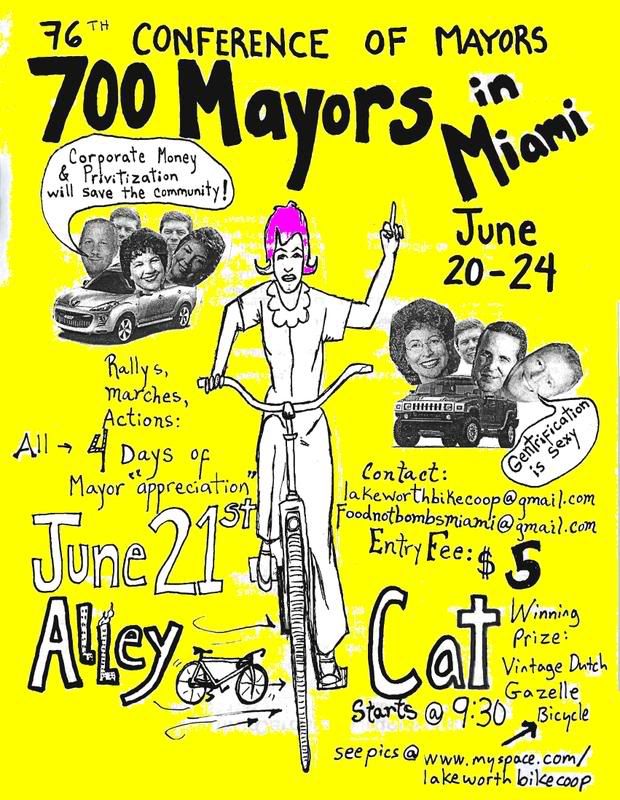 The upcoming United States Conference of Mayors (USCM) in Miami will be greeted by local residents and activist from around the country demanding an urban social policy that includes participatory democracy, community control of resources, and rejecting outside corporate influences who have a growing ability to reshape a community according to their profit driven vision, destroying the fabric of the community and the economic livelihood of it's people in the process. People are rightly demanding more direct democracy in order to regain control over the fate of their communities, and to develop them according to their own visions, not those of exploitative outside interests. - Editor
Local Residents Mobilize Against Mayors Conference
Source: http://news.infoshop.org/article.php?story=20080605152452471
Thursday, June 05 2008 @ 03:24 PM CDT
Contributed by: Anonymous
From June 20-24, 2008 community activists from around the country will be joining hundreds of local Miami residents to call attention to affordable housing, public space, gentrification, privatization, neoliberal policies, ecological destruction and other issues effecting urban communities in Miami and around the country.
Local Residents Mobilize Against Mayors Conference
Contact: 700 Mayors Welcoming Committee, 954.592.6330
FOR IMMEDIATE RELEASE
June 5, 2008
MIAMI, FL - Local Residents Mobilize Against Mayors Conference
Hundreds Will Rally For Community Control of Resources
From June 20-24, 2008 community activists from around the country will be joining hundreds of local Miami residents to call attention to affordable housing, public space, gentrification, privatization, neoliberal policies, ecological destruction and other issues effecting urban communities in Miami and around the country.
Grassroots activists from local groups including Everglades Earth First!, Food Not Bombs, 700 Mayors Welcoming Committee, Miami Workers Center, Power U Center for Social Change and Take Back the Land will be coordinating days of marches, rallies, bike rides, and a community festival, protesting what local 700 Mayors Welcoming Committee organizer Richard Magon describes as the "irresponsible and destructive policies of local governments; cutting deals with luxury developers and multinational corporations at the expense of the needs of local residents, communities and the Earth."
700 mayors from around the country will gather in Miami from June 20-24 at the Intercontinental Hotel for the 76th Annual Meeting of The United States Conference of Mayors (USCM) to debate national policy impacting America's cities and metropolitan areas. The USCM, founded in 1932 during the Great Depression, is an organization of cities with populations exceeding 30,000. Mayor of Miami Manny Diaz, who was credited with eliminating poverty in the city, is the current vice president of the USCM. Presidential candidates Hillary Clinton, Barack Obama and John McCain are also slated for an appearance.
"The 700 Mayors Welcoming Committee" says local organizer Voltairine DeCleyre, "is calling for an urban social policy built upon participatory democracy, community control of resources and for a move towards ecological sustainability." The coalition of groups is calling for "development strategies that value historic communities over the interests of luxury condominium developers."
Decleyre further states "vacant and unused properties should fall under the control of the community. We see community control of land and resources as essential in combating the housing crisis." The group's environmental agenda focuses on shifts to clean, renewable energy and for a move from automobile centered cities to cities that are geared to meet the needs of cyclists and those who rely on public transit.
Thursday, March 27, 2008
PARECON: PARTICIPATORY ECONOMICS
 In the following interview, Michael Albert expounds on his vision of the participatory economic model that he calls PARECON. Visit his website for more information (link below). - Editor
Michael Albert – On Participatory Economics
Source: http://www.re-public.gr/en/?p=46
Michael Albert has coined Parecon (participatory economics) as a term denoting a new type of post-capitalist, self-managing economy. He hopes that Parecon can help inspire and inform activism that wins a new type of classless economy.
An interview to Pavlos Hatzopoulos for Re-public
Pavlos Hatzopoulos: Is Parecon (participatory economics) a blueprint for a future society beyond capitalism?
I can also imagine, however, a description of key institutions central to all instances of capitalism, despite the many detailed differences each specific instance has from country to country and time to time. That would be a description of markets for allocation, of private ownership of productive assets, of remuneration for power and property and to an extent output, and of corporate divisions of labor. It would be skeletal and therefore not a blueprint, but it would be nonetheless important in specifying key attributes so that we could say useful things about capitalism per se, which is to say, about all instances of capitalism.
Parecon gives that kind of broad skeletal picture of a type or range of self-managing, classless economies that could come in many instances in different countries, times, etc. To provide that broad picture, or vision, parecon specifies key defining institutions including workers and consumers’ councils, balanced job complexes, remuneration for effort and sacrifice, and participatory planning. Parecon is therefore not a blueprint of another type of economy, but it is rather a broad description of central features of another type of economy. It is what we need, I think, if we are to be convincing that such an economy is possible and would be desirable.
You also ask about society, not economy, in that you ask if parecon is a blueprint of a new type society. Parecon isn’t even a picture of defining features of a new type participatory society, only of an economy. There is a big difference. To have a broad description of a societal vision rather than just an economic vision would entail having not only a picture for a new type economy–for example, parecon—but also a vision of key features of a new culture, polity, kinship, and perhaps some other aspects of society as well.
So, the bottom line is that parecon offers a picture of key defining features of a new type of post-capitalist, self-managing, and classless economy. It could be part of a picture of a new type of society, yes, but it certainly isn’t itself such a picture.
P.H.: In what sense is Parecon an initiative coming from below?
M.A.: In every sense that I can imagine. After all, what does “coming from below” actually mean? Presumably by “coming from above” you would mean thought up and imposed from some top-down perspective and serving elite interests, as well.
Parecon emerges, instead, from decades -really centuries- of grassroots activism and struggle to attain a classless economy. It learns from past experiments, both successes and failures, as well as from current ones. It is written accessibly, offered publicly. It welcomes and seeks debate, refinement, critique. It doesn’t favor some elite but embodies, instead, classlessness.
Ultimately, however, the extent to which parecon will be adopted and widely held by broad popular constituencies who make it their own, is still to be seen. That will depend on many variables, not least on its merits. Wide public advocacy by popular movements is of course the aim. The hope is that parecon can help inspire and inform activism that wins a new type of classless economy. I don’t know what “from below” would mean, if not these things.
Parecon and contemporary social movements
P.H.: Would you see Parecon as the answer to the question of what does the movement for an alternative globalization want?
M.A.: No, and also yes. That is, a movement against corporate globalization is almost by definition for internationalism, which means it is for some kind of equitable and solidaritious approach to trade and exchange among people internationally. Thus it would be against the IMF and World Bank and other institutions that seek to maintain or worsen the bias of international exchange toward enriching the already rich and impoverishing the already poor, but it would be for new international relations that would instead narrow the gap between rich and poor.
The thing is, no such approach can persist on top of each nation being capitalist in its domestic economic organization. So what I think is that while there are a great many very desirable steps that can be taken to move us away from the most egregious types of corporate globalization even before domestic economies are revolutionized away from capitalism, still, that domestic step is in the end essential, and yes, I think parecon provides answers regarding that step.
I also think that the values and norms of parecon, and its insights about social relations including markets, etc., can greatly assist people conceiving demands for immediate improvements in global relations. I have written some about that myself, indeed, and of course many others have, too.
P.H.: How has Parecon related so far to the World Social Forum process? There have been recent attempts to unite the organizations participating in the forum under a common political platform, like the Bamako Appeal. Is Parecon complementary to these prospects?
M.A.: I and others have participated regularly in the forums. I don’t know, however, what I think about the efforts you mention. On the one hand, I am not sure that the WSF constituency is the right one to try to galvanize into a new more programmatic organization and project. The wide array of people who relate to the WSF may be too politically diverse, on the one hand, including, for example, elements that aren’t anticapitalist, and perhaps also too separate from typical and important sectors of people in countries around the world, on the other hand.
It may be, in other words, that trying to get a degree of organizational unity out of the WSF constituencies would entail too many compromises of important commitments–as but one example, dispensing with overt anticapitalism to keep some groups involved. Or it could be that it would entail adopting some views that would distance the project from poorer elements worldwide, say. I just don’t know. Creating new organizations with activist agendas is certainly worth trying–and we certainly need something new internationally and in the U.S. too, even more so, for that matter. And of course trying out ideas is the way we find out whether they can work or not.
As to parecon and these efforts, well, yes, I do think that if it is to matter much over the long haul, any new international or domestic truly left organization needs to be anticapitalist. More, I think it can’t just say that capitalism sucks. Rather, if it wants to be convincing and to have its efforts accord with its aims, it has to be able to not only detail why capitalism sucks but, even more important, describe an economic alternative that would instead be highly desirable. That’s what I think parecon provides so that, yes, I do think parecon is not only complimentary with projects to create new domestic or international movements or organizations of the Left, but perhaps also essential to that effort. I guess time will tell if parecon’s advocates are right about that.
M.A.: They are projects that incorporate elements of pareconish structure and values, yes, and so yes, in that sense they are partial realizations of parecon–and there are many. The budgeting that you mention is one such experiment–though it doesn’t yet see itself as related to parecon, as far as I am aware of, at least. Actual workplaces that incorporate pareconish structures such as balanced job complexes are another such experiment, and there are now quite a few of those in various parts of the world, too. But I should say that I don’t think social change is a matter of only setting up such experiments and projects, as important as I think those efforts are. I also think it is essential to fight for a great many kinds of short and medium term gains, to better people’s lives now and to travel a path that leads toward parecon not in a few isolated projects, but throughout economies.
For example, to create a pareconish workplace is good. Doing so can inspire and instruct by example and by lessons, as well as benefit those involved. Doing so begins to plant the seeds of the future in the present. Likewise, to create an experiment in budgetary planning that has some elements of pareconish values and practices is also good, of course. But to create workers councils in large capitalist firms, and consumer councils in neighbourhoods and regions–in part inspired and guided by the other projects and giving them their reason for being—and to then fight and win innovations moving populations and structures toward pareconish commitments, will be even better. One can imagine all kinds of gains such movements can win–redistributive taxes, higher wages, changes in property laws, changes in the division of labor, a shorter work week, and so on.
The point is, with a pareconish commitment, both efforts to organize future-oriented small projects or experiments or workplaces, etc., and also wider movement efforts to win gains in the present would be informed by and would seek to enhance and enlarge support for visionary and strategic commitment to balanced job complexes, equitable remuneration, council-based self-management, and participatory planning.
P.H.: How do you explain the fact that these participatory experiments are springing up within the framework of existing capitalist relations?
M.A.: Well, where else would they spring up? I mean that seriously. It occurs more aggressively where a state is fostering the projects, whether in local venues like for the participatory budgets in Brazil and now some other places too, or even in a whole country as with the many experiments and projects under way in Venezuela, but in any event what we have in the world is overwhelmingly capitalism. So, anticapitalists–or even just people trying to improve their lives or enlarge justice without ideological comittments–can be expected to try to carve out space or win gains where they are, which is inside capitalism–and so, as you say, that’s what we see. I don’t actually think there is anything to explain, unless I am missing something.
Further links: